# Booster Auto-Upgrade
Centralized Booster upgrade from within FileWave, including single-Booster upgrades, multi-Booster scheduling, and monitoring. Starting with FileWave 16.3.0, compatible outdated Boosters can also be automatically scheduled for upgrade after a FileWave Server upgrade.
# Upgrading a Single Booster
## What
The Booster upgrade feature gives FileWave administrators a centralized way to upgrade Boosters from within FileWave.
## When/Why
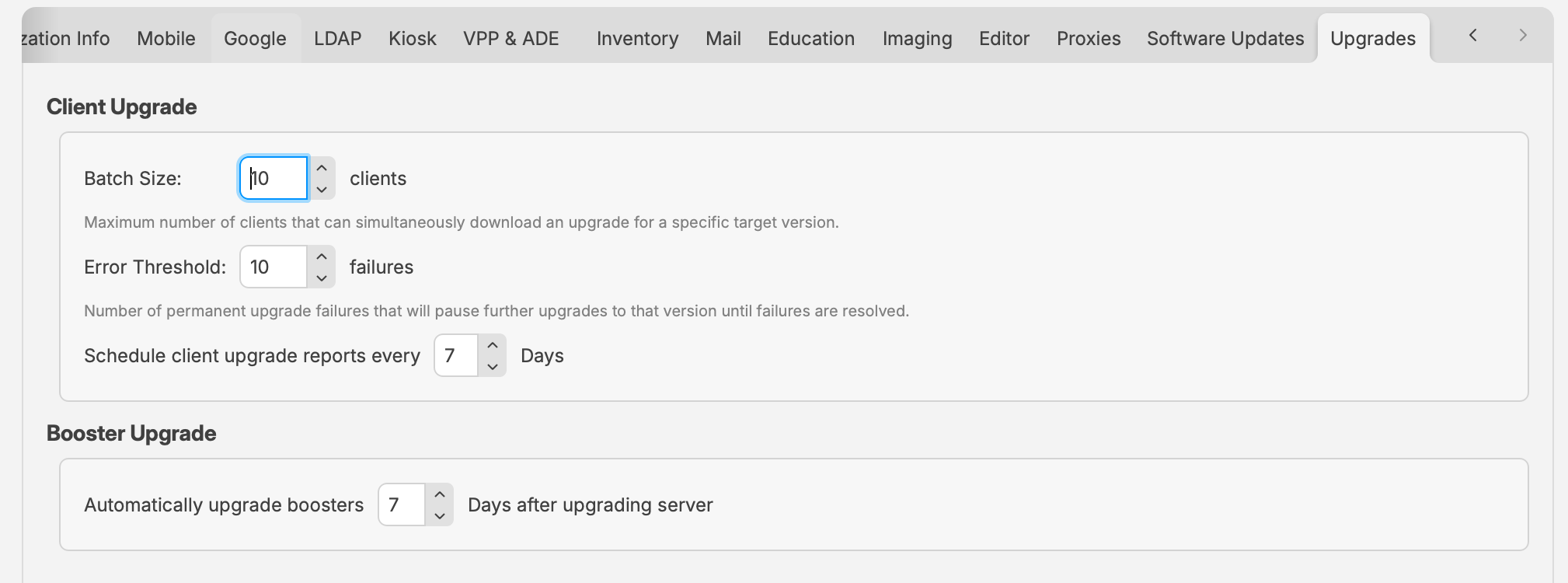
Having to use SSH or remote control for every Booster upgrade takes too much time. Starting with FileWave 14.4, the **Boosters** and **Booster Details** tabs provide a manual upgrade action when an applicable upgrade is available. Starting with FileWave 16.3.0, compatible outdated Boosters can also be scheduled automatically after a FileWave Server upgrade. The default delay is seven days. On FileWave 16.3.x, change it in **FileWave Central > Preferences > General**. Starting with FileWave 16.4.0, the setting is in **FileWave Central > Preferences > Upgrades**. Make the change before upgrading the Server. A value of **0 days** schedules eligible Boosters immediately. The value is evaluated when the Server upgrade creates the Booster schedule; changing it afterward does not retroactively move already scheduled work.
**FileWave 16.4 makes automatic Booster upgrades more resilient.** FileWave now checks both the reported upgrade status and the installed Booster version before treating an upgrade as complete. A failed attempt can be retried automatically within defined limits, and the attempts are logged. If the Booster remains below the target version or reports **Failed** after the automatic retries, investigate the logs and manually schedule the upgrade again.
Some criteria used to determine whether an applicable upgrade is available are:
- Booster has to be at least 14.4
- The operating system version has to be supported by the target version
- The booster has to be running in order to trigger an upgrade
- The version number of the target version has to be higher than the currently installed version (i.e you cannot use this feature to reinstall/downgrade to a specific version)
This article discusses manually upgrading a single Booster immediately. In FileWave 16.3.0 and later, this is especially useful when you do not want to wait for the automatic post-Server-upgrade schedule or when you want to handle one Booster separately.
## How
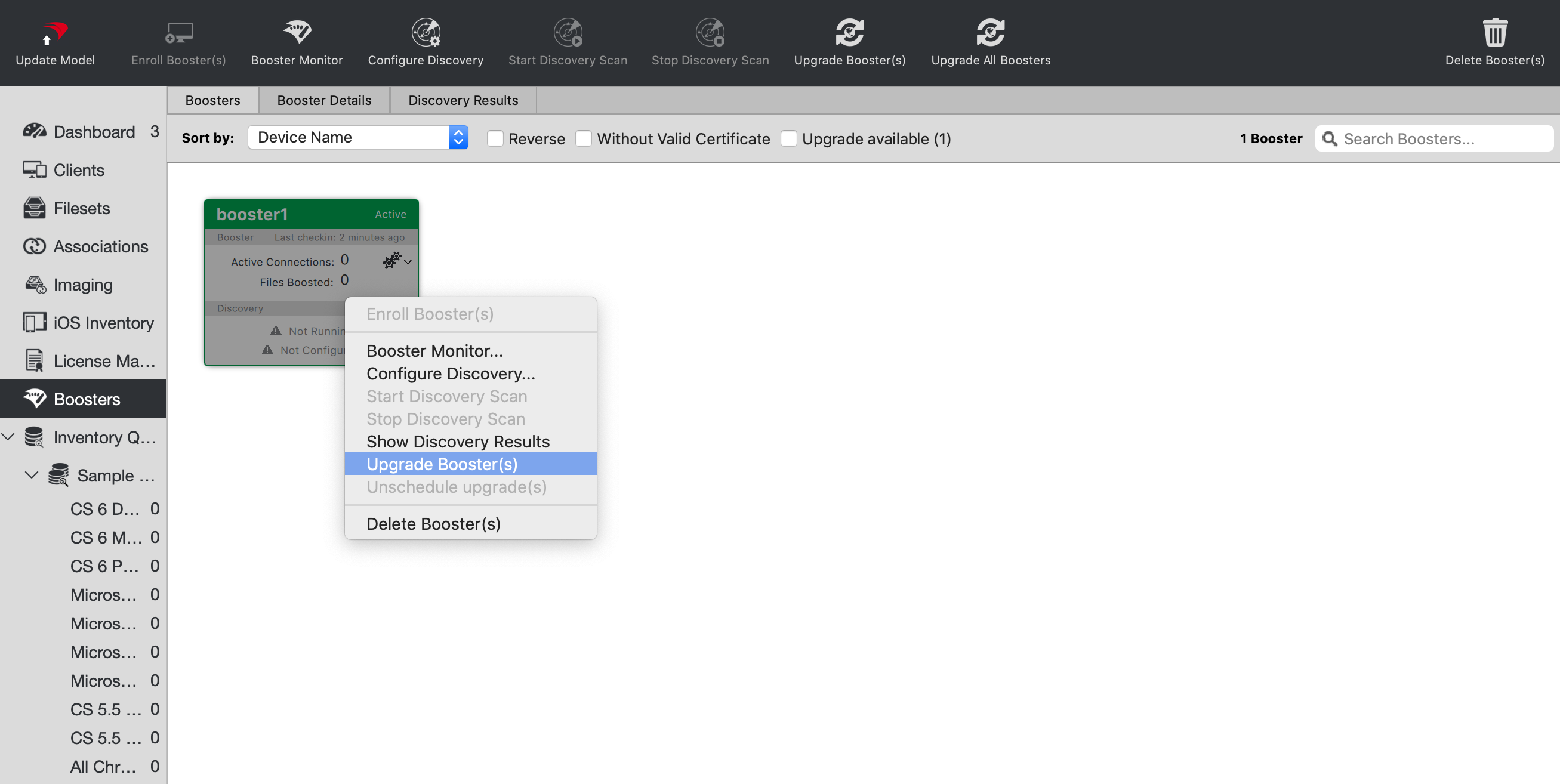
To upgrade a particular booster, just right-click it and select "Upgrade Booster". You can also right-click the booster in the "Booster Details" tab.
[](https://kb.filewave.com/uploads/images/gallery/2023-06/r3ScZN0RXRq9tPD8-upgrade-booster.png)
# Upgrading Multiple Boosters
## What
The Booster upgrade feature gives FileWave administrators a centralized way to upgrade multiple Boosters from within FileWave.
## When/Why
Having to use SSH or remote control for every Booster upgrade takes too much time. Starting with FileWave 14.4, the **Boosters** and **Booster Details** tabs provide manual upgrade actions when an applicable upgrade is available. Starting with FileWave 16.3.0, compatible outdated Boosters can also be scheduled automatically after a FileWave Server upgrade. The default delay is seven days. On FileWave 16.3.x, change it in **FileWave Central > Preferences > General**. Starting with FileWave 16.4.0, the setting is in **FileWave Central > Preferences > Upgrades**. Make the change before upgrading the Server. A value of **0 days** schedules eligible Boosters immediately. The value is evaluated when the Server upgrade creates the Booster schedule; changing it afterward does not retroactively move already scheduled work.
**FileWave 16.4 makes automatic Booster upgrades more resilient.** FileWave now checks both the reported upgrade status and the installed Booster version before treating an upgrade as complete. Failed attempts can be retried automatically within defined limits, and each attempt is logged. Use the Booster views to confirm the installed version and identify Boosters that still require manual attention after retries are exhausted.
Some criteria used to determine whether an applicable upgrade is available are:
- Booster has to be at least 14.4
- The operating system version has to be supported by the target version
- The booster has to be running in order to trigger an upgrade
- The version number of the target version has to be higher than the currently installed version (i.e you cannot use this feature to reinstall/downgrade to a specific version)
This article discusses manually scheduling upgrades for multiple Boosters. In FileWave 16.3.0 and later, it also complements the automatic post-Server-upgrade scheduling workflow when you want to start upgrades immediately or control the selection yourself.
## How
It is also possible to schedule multiple Boosters for upgrade at once. In this case, one Booster will be upgraded after another in alphabetical order. In FileWave 16.3.0 and later, compatible outdated Boosters may already be scheduled automatically after a Server upgrade. The simplest way to start that process immediately, or to manually schedule multiple Boosters yourself, is to use the "Upgrade All Boosters" button in the toolbar of the Boosters section of the native console:
It automatically schedules all selected Boosters to upgrade. Alternatively, you can select multiple Boosters and use the context menu or toolbar button to upgrade them.
**The preference moved in FileWave 16.4.**
- **FileWave 16.3.x:** **FileWave Central > Preferences > General**
- **FileWave 16.4.0 and later:** **FileWave Central > Preferences > Upgrades**
The default delay is **7 days after upgrading the Server**. Set it to **0 days** before the Server upgrade when eligible Boosters should be scheduled immediately. This preference is evaluated when the Server upgrade creates the Booster schedule, so changing it afterward does not retroactively reschedule Boosters already in the queue.
On FileWave 16.3.x, a failed automatic attempt requires administrator intervention. Starting with FileWave 16.4.0, FileWave validates the reported result against the installed Booster version and can retry failed attempts automatically within defined limits. If a Booster still reports **Failed** or remains below the target version after those retries, inspect its upgrade log and schedule it again manually.
[](https://kb.filewave.com/uploads/images/gallery/2026-07/uDJ1CnzK9q0cqbFF-hosted-server-16-4-upgrade-settings.png)
*FileWave Central 16.4.0 and later: the automatic Booster-upgrade delay is in the **Upgrades** preferences tab.*
To track the progress of upgrading multiple boosters, you can use the new **Booster Upgrade status** field mentioned earlier. You can also use the new check box **Upgrade available** which allows you to filter out boosters that have no upgrade available. This check box is displayed in both the **Boosters** and **Booster Details** tabs:


With this new functionality, the process to upgrade Boosters should be greatly simplified, especially for larger environments.
## Related Content
- [Booster deployment planning](https://kb.filewave.com/books/boosters/page/booster-deployment-planning "Booster Deployment Planning")
- [Booster installation](https://kb.filewave.com/books/boosters/page/booster-installation "Booster Installation")
- [Upgrading a Single Booster](https://kb.filewave.com/books/boosters/page/upgrading-a-single-booster "Upgrading a Single Booster")
- [Reporting / Monitoring Booster Upgrade Process](https://kb.filewave.com/books/boosters/page/reporting-monitoring-booster-upgrade-process "Reporting / Monitoring Booster Upgrade Process")
# Reporting / Monitoring Booster Upgrade Process
## What
The Booster upgrade feature gives FileWave administrators a centralized way to schedule and monitor Booster upgrades from within FileWave.
## When/Why
Having to use SSH or remote control for every Booster upgrade takes too much time. Starting with FileWave 14.4, the **Boosters** and **Booster Details** tabs provide upgrade actions when an applicable upgrade is available. Starting with FileWave 16.3.0, compatible outdated Boosters can also be scheduled automatically after a FileWave Server upgrade. The default delay is seven days. On FileWave 16.3.x, change it in **FileWave Central > Preferences > General**. Starting with FileWave 16.4.0, the setting is in **FileWave Central > Preferences > Upgrades**. Make the change before upgrading the Server. A value of **0 days** schedules eligible Boosters immediately. The preference is evaluated when the Server upgrade creates the schedule; changing it afterward does not retroactively move work already in the queue.
Starting with FileWave 16.4.0, automatic Booster reporting validates the installed version as well as the reported status, and failed attempts can be retried automatically within defined limits.
Some criteria used to determine whether an applicable upgrade is available are:
- Booster has to be at least 14.4
- The operating system version has to be supported by the target version
- The booster has to be running in order to trigger an upgrade
- The version number of the target version has to be higher than the currently installed version (i.e you cannot use this feature to reinstall/downgrade to a specific version)
This article discusses the reporting and monitoring functions around both manually scheduled Booster upgrades and the automatic post-Server-upgrade scheduling introduced in FileWave 16.3.0.
## How
In the "Booster Details" tab, there are three fields that indicate the status of the Booster upgrade queue. These fields apply whether the upgrade was scheduled manually or automatically after a Server upgrade:

**Upgrade Status** - This field shows the current progress of the booster with one of the below statuses:
- **No upgrade in progress:** Currently, no upgrade is being installed. This status is also shown when the last upgrade was successful.
- **Downloading:** Indicates that the booster is currently downloading a new booster upgrade from the server; a necessary step before the upgrade can be installed.
- **Installing:** The booster is currently installing an update. This should either lead to the "No upgrade in progress" or "Failed" state. The default timeout is one hour.
- **Failed:** Indicating the upgrade was unable to complete.
**Available Upgrade Version** - Reports which upgrade version is available to this particular booster, given its operating system.
**Scheduled for Upgrade** - This flag indicates whether the booster is in the current upgrade queue.
- '**true**': Booster is either processing an upgrade or waiting for a preceding Booster to finalize an upgrade, including failures.
- '**false**': No upgrade is scheduled
**Automatic-upgrade behavior depends on the FileWave version.**
- **FileWave 16.3.x:** each Booster receives one automatic attempt in the scheduled run. A failure can require the administrator to address the Booster or remove it from the schedule before continuing.
- **FileWave 16.4.0 and later:** FileWave verifies both the reported upgrade result and the installed Booster version before marking the work complete. Failed attempts can be retried automatically within defined limits, and each attempt is logged.
After a FileWave 16.4 retry sequence, investigate any Booster that still reports **Failed** or remains below the **Available Upgrade Version**. Do not treat a restart or **No upgrade in progress** status by itself as proof that the target version was installed.
**Related Content**
- [Booster deployment planning](https://kb.filewave.com/books/boosters/page/booster-deployment-planning "Booster Deployment Planning")
- [Booster installation](https://kb.filewave.com/books/boosters/page/booster-installation "Booster Installation")
- [Upgrading a Single Booster](https://kb.filewave.com/books/boosters/page/upgrading-a-single-booster "Upgrading a Single Booster")
- [Upgrading Multiple Boosters](https://kb.filewave.com/books/boosters/page/upgrading-multiple-boosters "Upgrading Multiple Boosters")
## Digging Deeper
When an upgrade is triggered through FileWave Central, the server sends a notification to the Booster with a URL parameter pointing to the upgrade package (deb for Linux, pkg for Mac, MSI for Windows) that shall be downloaded and installed. Currently, this URL will point to the FileWave CDN ([https://fwdl.filewave.com/](https://fwdl.filewave.com/)) for official releases. Both "Boosters" and "Booster Details" view offer a filter to only show Boosters that can be upgraded.
The location for auto upgrade logs is;
- Linux and MacOS: `/var/log/fwbooster_upgrade.log`
- Windows: `C:\ProgramData\FileWave\FWBooster\Data Folder\upgradeBooster.log`