# Let's Encrypt Setup for FileWave Server (Debian)
## What
This Knowledge Base (KB) article covers a Debian-focused shell script that automates Let's Encrypt SSL certificate setup for a FileWave server on Debian 12/13.
The script supports **two challenge methods**:
- **HTTP-01 (standalone certbot)**
- **DNS-01 (Cloudflare)**
Both paths handle certificate request, FileWave certificate injection, and renewal automation.
## When/Why
FileWave administrators use this when they need a trusted SSL certificate for secure communication.
- Use **HTTP-01** when port 80 can be reached from the internet.
- Use **DNS-01 (Cloudflare)** when port 80 is blocked/unavailable or you prefer DNS validation.
This documented process is for Debian 12/13. If you are a Hosted customer, FileWave can handle certificate management for you: [SSL Certificate Management for Custom Domains (FileWave-Hosted Servers)](https://kb.filewave.com/books/community-engagement/page/ssl-certificate-management-for-custom-domains-filewave-hosted-servers).
## How
### Prerequisites
- FileWave server on Debian 12 or 13
- Root/sudo access
- Public DNS name (FQDN) for the FileWave server
- If using DNS validation: Cloudflare API token with DNS edit permissions for the zone
### Challenge method guidance
- **HTTP-01**: requires inbound TCP/80 reachability for Let's Encrypt validation. Also verify that any host firewall on the FileWave Server allows HTTP on port 80; on systems using `firewalld`, check with `sudo firewall-cmd --list-services` or `sudo firewall-cmd --list-ports`.
- **DNS-01 (Cloudflare)**: does not require inbound TCP/80.
If TCP/80 is not available, select DNS-01 (Cloudflare) during install.
If HTTP-01 fails even though DNS is correct, check both upstream network access and the local server firewall. For a Debian server using `firewalld`, allow HTTP with `sudo firewall-cmd --permanent --add-service=http` followed by `sudo firewall-cmd --reload`. Keep port 80 reachable for HTTP-01 renewals, or use DNS-01 if you cannot keep HTTP open.
### Install steps
1. Download the script with `wget`:
```bash
wget -O filewave-letsencrypt-debian.sh https://kb.filewave.com/attachments/413
```
2. Make it executable:
```bash
chmod +x filewave-letsencrypt-debian.sh
```
3. Run install:
```bash
sudo ./filewave-letsencrypt-debian.sh --install
```
4. Follow prompts for:
- Hostname (FQDN)
- Email
- Validation method:
- `1` = HTTP-01
- `2` = DNS-01 (Cloudflare)
- If DNS-01 is selected: Cloudflare API token
5. Confirm values when prompted.
6. Verify output for success messages and final summary.
### What the script does
- Validates Debian and root execution
- Validates that FileWave server paths exist (`/usr/local/bin/fwcontrol`, `/usr/local/filewave/certs`)
- Validates hostname and email
- Validates DNS resolution (tries `8.8.8.8`, then system resolver fallback)
- Backs up existing certs under `/usr/local/filewave/certs/backup-/`
- Installs/validates certbot
- Requests a new certificate using selected challenge method
- For DNS-01 (Cloudflare): creates `/etc/letsencrypt/secrets/cloudflare.ini` automatically (no manual pre-creation required)
- Updates FileWave `mdm_cert_trusted` DB flag
- Creates renewal deploy hook:
- `/etc/letsencrypt/renewal-hooks/deploy/filewave-server-cert.sh`
- Preserves existing cert file owner/group when replacing certificates
- Creates daily renewal cron:
- `/etc/cron.daily/letsencrypt-filewave`
- Immediately injects cert into FileWave and restarts server services
### Uninstall
To remove integration files created by the script:
```bash
sudo ./filewave-letsencrypt-debian.sh --uninstall
```
This removes FileWave renewal hook + cron job and (if present) Cloudflare credentials file. The script intentionally leaves certbot installed.
## Troubleshooting
### 1) FileWave server prerequisites failed
If script reports missing FileWave binaries/paths:
- Verify `/usr/local/bin/fwcontrol` exists.
- Verify `/usr/local/filewave/certs` exists.
- Re-run on the FileWave server host.
### 2) Certificate request failed (HTTP-01)
Ensure inbound TCP/80 is reachable, then retry:
```bash
sudo certbot -n --agree-tos --standalone certonly -d "" -m ""
sudo certbot renew --force-renewal
```
### 3) Certificate request failed (DNS-01 Cloudflare)
Ensure token permissions and retry:
```bash
sudo certbot -n --agree-tos --dns-cloudflare --dns-cloudflare-credentials /etc/letsencrypt/secrets/cloudflare.ini certonly -d "" -m ""
sudo certbot renew --force-renewal
```
### 4) FileWave UI shows old certificate behavior
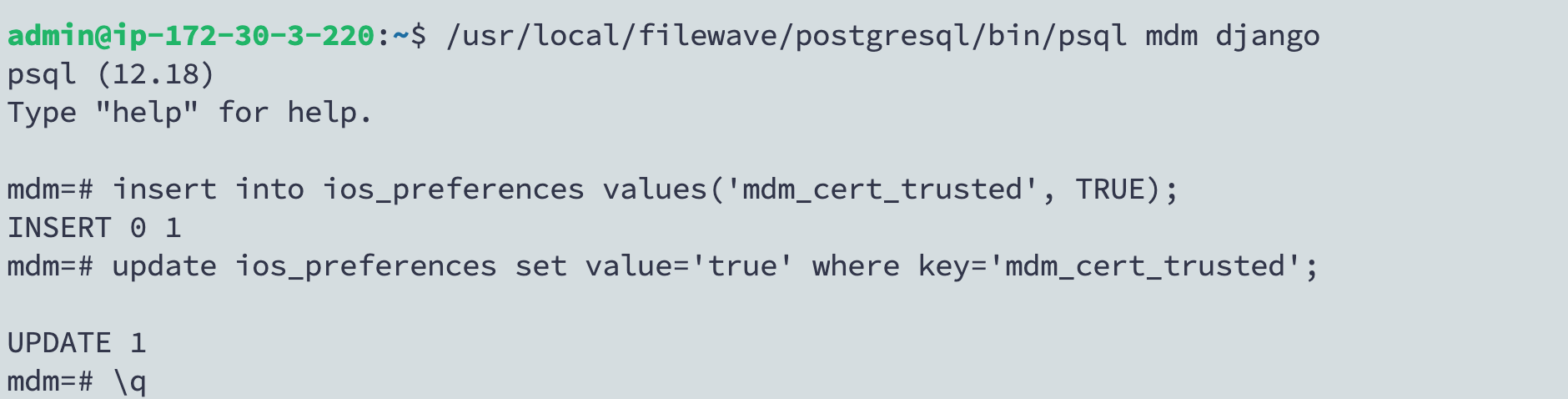
If older behavior persists, verify `mdm_cert_trusted` is set in PostgreSQL:
[](https://kb.filewave.com/uploads/images/gallery/2024-04/eA3cs5zaHHovAvxm-image.png)
```sql
/usr/local/filewave/postgresql/bin/psql -d mdm -U django
insert into ios_preferences values('mdm_cert_trusted', TRUE) on conflict (key) do nothing;
update ios_preferences set value='true' where key='mdm_cert_trusted';
\q
```
## Related Links
- [Let's Encrypt Documentation](https://letsencrypt.org/docs/)
- [Cloudflare DNS plugin for Certbot](https://certbot-dns-cloudflare.readthedocs.io/)
- [GitHub - nycon/filewave-installer: Filewave AIO installer](https://github.com/nycon/filewave-installer/tree/main)
- [Review My Notes: FileWave and Let's Encrypt | Version 12.0 (punkstuff.com)](https://punkstuff.com/filewave-new-secure-certificate)