**iOS 27 and iPadOS 27 are prerelease.** These report definitions use Apple’s compatibility lists published with the June 2026 previews. Apple may revise support before the public release, so check the linked Apple pages again before approving a broad upgrade.
The compatible report includes devices whose hardware identifier is on the published list or whose reported operating-system version already begins with `27`. This means newly released hardware that ships with iOS or iPadOS 27 still appears as compatible before its hardware identifier is added to the report. The incompatible report is limited to iPhone and iPad inventory and intentionally excludes Apple TV and tvOS. ## Apple’s published compatibility list - **iPhone:** iPhone 11 and later, including iPhone SE (2nd generation and later). - **iPad Pro:** 12.9-inch (4th generation and later), 11-inch (2nd generation and later), and M4 or later models. - **iPad Air:** 4th generation and later, including supported 11-inch and 13-inch M-series models. - **iPad:** 9th generation and later, including iPad (A16). - **iPad mini:** 6th generation and iPad mini (A17 Pro). The iPhone compatibility floor is unchanged from iOS 26. For iPadOS 27, Apple no longer lists iPad Pro 11-inch (1st generation), iPad Pro 12.9-inch (3rd generation), iPad Air (3rd generation), iPad (8th generation), or iPad mini (5th generation). The reports match the current FileWave inventory identifiers `iPhone12,*` through `iPhone18,*`, `iPad8,9` through `iPad8,12`, and `iPad12,*` through `iPad17,*`. The four supported `iPad8` identifiers are listed individually because a broad `iPad8,*` match would also include older iPad Pro models that are not on Apple’s iPadOS 27 list. Sources: [Apple: iOS 27 Preview](https://www.apple.com/os/ios/) and [Apple: iPadOS 27 Preview](https://www.apple.com/os/ipados/). ## Ingredients - FileWave Central access with permission to manage Reports - The compatible and incompatible iOS/iPadOS 27 Inventory Report JSON files| Compatible report | Incompatible report |
| [ios27\_compatible.json](https://kb.filewave.com/attachments/531) | [ios27\_incompatible.json](https://kb.filewave.com/attachments/532) |
**Historical reference:** The original iOS 16 and iOS 17 JSON definitions remain available in this page’s **Attachments** panel. Use the iOS/iPadOS 27 files above for current compatibility planning.
## Directions ### Import in FileWave Central (recommended) 1. Download `ios27_compatible.json` and `ios27_incompatible.json` from the table above. 2. Open FileWave Central and select **Reports**. 3. Choose either **Import Reports** in the toolbar or right-click in the report list and choose **Import Report**. 4. Select `ios27_compatible.json` and complete the import. 5. Repeat the import for `ios27_incompatible.json`. 6. Open the imported reports in FileWave Central or FileWave Anywhere and compare the results with your current device inventory. 7. Before scheduling upgrades, confirm Apple’s final compatibility lists and pilot iOS/iPadOS 27 on representative hardware. [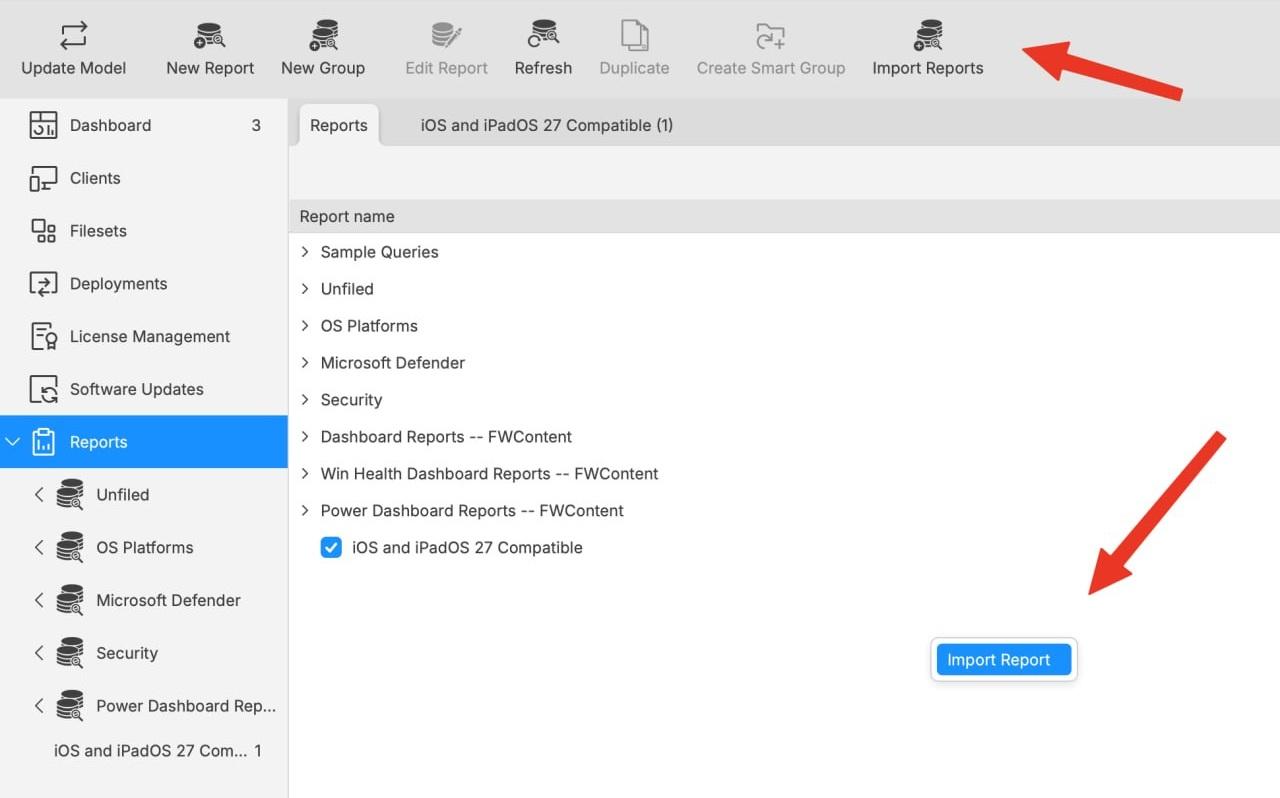](https://kb.filewave.com/uploads/images/gallery/2026-07/WpCp4ZmFTG1ZQaxl-filewave-central-import-reports-two-ways.jpg)Both controls open the report-import workflow. The toolbar label is **Import Reports**; the right-click action is **Import Report**.
For general report import and export guidance, see [Exporting & Importing Inventory Reports](https://kb.filewave.com/books/filewave-central-anywhere/page/exporting-importing-inventory-reports). For automated JSON deployment, see [Command Line API (v1): Import an Inventory Report definition from JSON](https://kb.filewave.com/books/application-programming-interface-api/page/command-line-api-v1#bkmrk-import-report-json).