TeamViewer Pre-Requisites
- TeamViewer General Pre-Requisites
- TeamViewer: Chrome OS Client Setup
- TeamViewer: iOS/iPadOS Client Setup
- TeamViewer: macOS Client Setup
- TeamViewer: Windows Client Setup
- TeamViewer: Android EMM Client Setup
TeamViewer General Pre-Requisites
What
Each operating system platform will have its own set of pre-requisites that need to be satisfied before you can use the TeamViewer solution through FileWave.
When/Why
First, your FileWave Admin Account will need to have a license assigned to your account: https://kb.filewave.com/books/teamviewer/page/teamviewer-assigning-licenses
To remote to and control devices, will require your macOS or Windows device to have the full version of TeamViewer:
Your managed clients will also need to have a version of TeamViewer installed. We recommend the Host version:
- Windows Clients - TeamViewer Deployment
- macOS Clients - TeamViewer Deployment
- IOS/iPadOS Devices - TeamViewer Deployment
- ChromeOS - TeamViewer Deployment
- Android - TeamViewer Deployment
We'll see conditional options in the FileWave Native and Web Administrator consoles (shown below) for a TeamViewer session whenever pre-requisites are met:


Computer Client Preferences
Computer clients also rely upon the client settings for these options to be available:
- FileWave Client Preferences > Privacy
There are two options available:
- Managed remote control
- Prompt client for remote control access

The first option will allow/deny any connection via TeamViewer. The second option will be considered when the first option is enabled.
The second option, for prompting, will then either allow only one or both options to be available. When prompt is disabled, both the options to either prompt or not prompt should be available. If Prompt is enabled though, the option to action a 'Don't prompt user' will not be available and only prompted connections may be established.
These options may be configured with a Superpref Fileset.
How
The following table highlights specific prerequisites for complete functionality and helpful tips:
| Platform | FW Server | FW Client | Companion App/Kiosk/Extension | Supporting Apps |
| Windows/macOS | Version 14.7+ | Version 14.7+ | n/a | TeamViewer App pre-deployed |
| iOS/iPadOS | Version 14.7+ | n/a | FileWave Kiosk IPA v 14.6+ | TeamViewer QuickSupport App (Licensed through VPP and deployed) |
| Android | Version 14.7+ | n/a | Companion App v 14.6+ (auto-deployed) | TeamViewer QuickSupport App required, TeamViewer device-specific add-on also needed for device control |
| Chrome OS | Version 14.7+ | n/a | Extension v 2021.10.07 (auto-deployed) | TeamViewer QuickSupport App required, QS add-on eventually for device control |
- Note that 14.6 was a Tech Preview for Team Viewer and should work aside from Unattended access, but 14.7 is when TV support moved to production release.
For specific setup instructions, view each of the platform-specific articles.
For notifications to be able to be sent to your remote devices, you'll need to make sure to open traffic from your FileWave server to rcs.filewave.com and fwpn.filewave.com on port 443. These are two new services that accept the session creation and push notification requests respectively.
There are several setup-related items we'll need to take care of before we can use TeamViewer, and we'll go through them in order in the related articles found below. There are also videos located in the Foundry here: https://foundry.filewave.com/course/view.php?id=19 (NOTE: When logging in tot he Foundry make sure to "Login via SSO")
TeamViewer: Chrome OS Client Setup
What
FileWave's TeamViewer integration requires endpoint prerequisites on each supported platform. In future versions, we may embed some of these prerequisites, but at this time, we erred on the side of letting you control the elements. So, slightly more work but much greater control.
When/Why
We'll need to meet prerequisites for ChromeOS client devices for TeamViewer to work seamlessly. Specifically, we'll need the following:
-
FileWave server to be upgraded to at least 14.7
-
TeamViewer full client installed where you run the FileWave Central (Native) or Anywhere (Web)
-
The FileWave Inventory Extension is installed and up to date (version 2021.10.07+)
-
The inventory extension is required because it is the element that receives the notification to start the TV session
-
If the extension is already being pushed, it will simply auto-update when the new version is approved (currently under review)
-
Note that because this is a browser extension, the browser MUST be open for the TV session to work
-
-
The Google Play Store TeamViewer QuickSupport App installed
- The QuickSupport app allows screen sharing
Although TeamViewer does not support remote control of Chrome OS devices, it has been seen to work (but without consistency) in some instances by applying the QS Universal Add-on. As such, the add-on could also be considered.
* The Google Play Store TeamViewer QS Universal Add-On
* The add-on allows device control
How
TeamViewer’s full application for Windows can be found here: https://www.teamviewer.com/en-us/download/windows/ For macOS here: https://www.teamviewer.com/en-us/download/mac-os/. You will need to run that on the device that runs the FileWave Administrator console or WebAdmin. For your clients, the below steps discuss the deployment of TeamViewer Host.
If you aren't currently distributing the FileWave Chromebook Inventory Extension, you'll want to do that, and detailed instructions can be found here.
Details about what the Inventory Extension enables, and frequently asked questions can be found here and here respectively.
Additionally, it will be very helpful to pre-deploy the QuickSupport App and the Universal Add-On through your Google Admin Console. In our environment, we chose to push both:

Note that both apps are from the Google Play Store, not from the Chrome store:

TeamViewer: iOS/iPadOS Client Setup
What
For iPhone and iPad remote support, plan for the FileWave Kiosk app, TeamViewer QuickSupport, a technician workstation running TeamViewer, and Apple user approval for screen control.
When/Why
Requirements:
- FileWave Kiosk app. Kiosk V2 installs it automatically.
- TeamViewer QuickSupport app from the App Store, deployable through MDM with VPP.
- A supported FileWave and TeamViewer integration configuration. Available view/control options vary by Apple platform and OS version.
- User approval for screen control. Apple requires this for user privacy.
Apple requires the user to approve screen control on iOS/iPadOS devices. FileWave and TeamViewer cannot bypass that privacy prompt.
Older FileWave deployments may still have manually deployed the FileWave Kiosk IPA. In current Kiosk V2 deployments, FileWave installs the Kiosk app automatically.
How
TeamViewer Full Application
The technician's computer needs the full TeamViewer application, available from the TeamViewer download pages:
- Windows: https://www.teamviewer.com/en-us/download/windows/
- macOS: https://www.teamviewer.com/en-us/download/mac-os/
TeamViewer QuickSupport
The iPhone or iPad needs TeamViewer QuickSupport from the App Store:
- TeamViewer QuickSupport App Store Link
- If searching for the App, e.g in Apple Business or School Manager, the App ID is: 661649585
TeamViewer QuickSupport is a free App.
Deploy the required apps through FileWave before testing remote support.
Test on a small device group before broad deployment.
TeamViewer through FileWave requires a TeamViewer license assigned to the FileWave administrator who starts the session in Manage Administrator Preferences. Only assigned administrators can control devices.
TeamViewer: macOS Client Setup
What
FileWave version 14.7 introduced a TeamViewer integration that requires endpoint prerequisites on each supported platform. The majority of these have been left untouched, but may be altered, allowing slightly more work (if desired) but much greater control.
When/Why
TeamViewer is used to remotely control your clients, providing access to a device for troubleshooting or assisting a user. TeamViewer for macOS differs from other OSs since it requires a few privacy permissions before allowing TeamViewer to be installed.
How
Prerequisites for macOS client devices must be met for TeamViewer to work seamlessly:
-
General TeamViewer Prerequisites are met, ensuring that clients are set to allow remote control
-
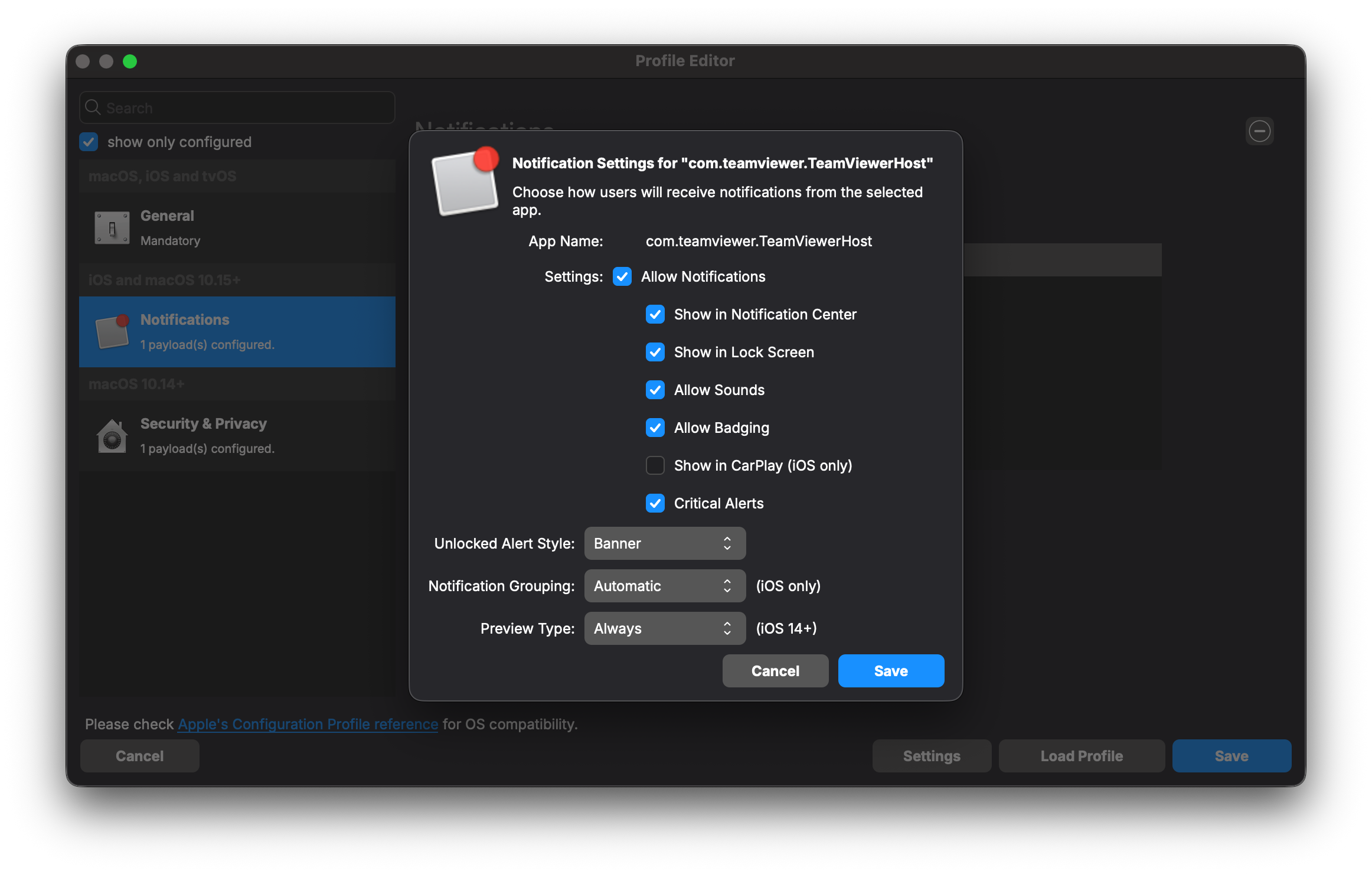
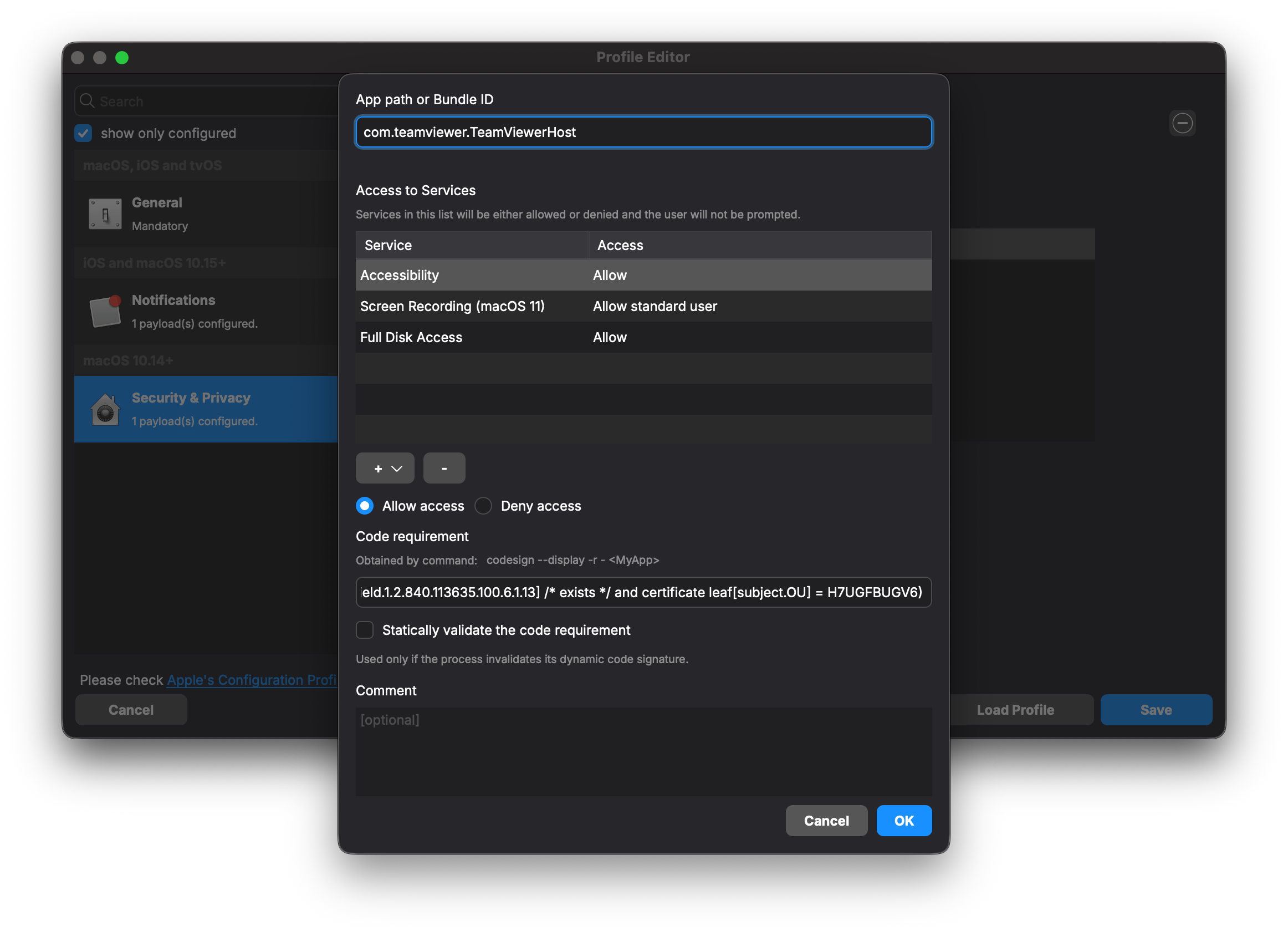
Profile for TeamViewer Host - Notifications, Accessibility, and Full Admin Access
- *TeamViewer Full Client Application is installed on the device initiating the session.
*The TeamViewer Full Client application is only necessary for computers that need to remotely connect to other computers. You can download the TeamViewer Full Client here: https://www.teamviewer.com/en-us/download/portal/
The below describes the process for deploying and configuring the TeamViewer Host application. The Host application is only allowed to accept connections and not initiate them, and is highly recommended for client deployment.
TCC Profile for TeamViewer Host - Accessibility, Notifications, Screen Recording, and Full Admin Access
Screen Recording is a privacy setting that can not be allowed by anyone other than a local user. Standard Users do not have permissions to allow Screen Recording by default. In the current Profile, the option to allow a non-Admin to accept Screen Sharing is enabled.
This option is available starting in macOS Big Sur (11). If you have clients running older versions, please deploy the Legacy profile.
Privacy Settings Profiles
Permissions to allow TeamViewer access rights.
TCC Profile for TeamViewer Host (current):
Profile - TeamViewerHost15.fileset
TCC Profile for TeamViewer Host (Legacy, before macOS Big Sur):
Profile - TeamViewerHost15 < macOS Big Sur.fileset
TeamViewer Host Fileset
The included Fileset utilizes a settings file, set to install the software silently. This Fileset is current at the time of this article's publishing date.
Current TeamViewer Fileset: macOS TeamViewer Host Install 15.70.4.fileset.zip
Fileset Contents:
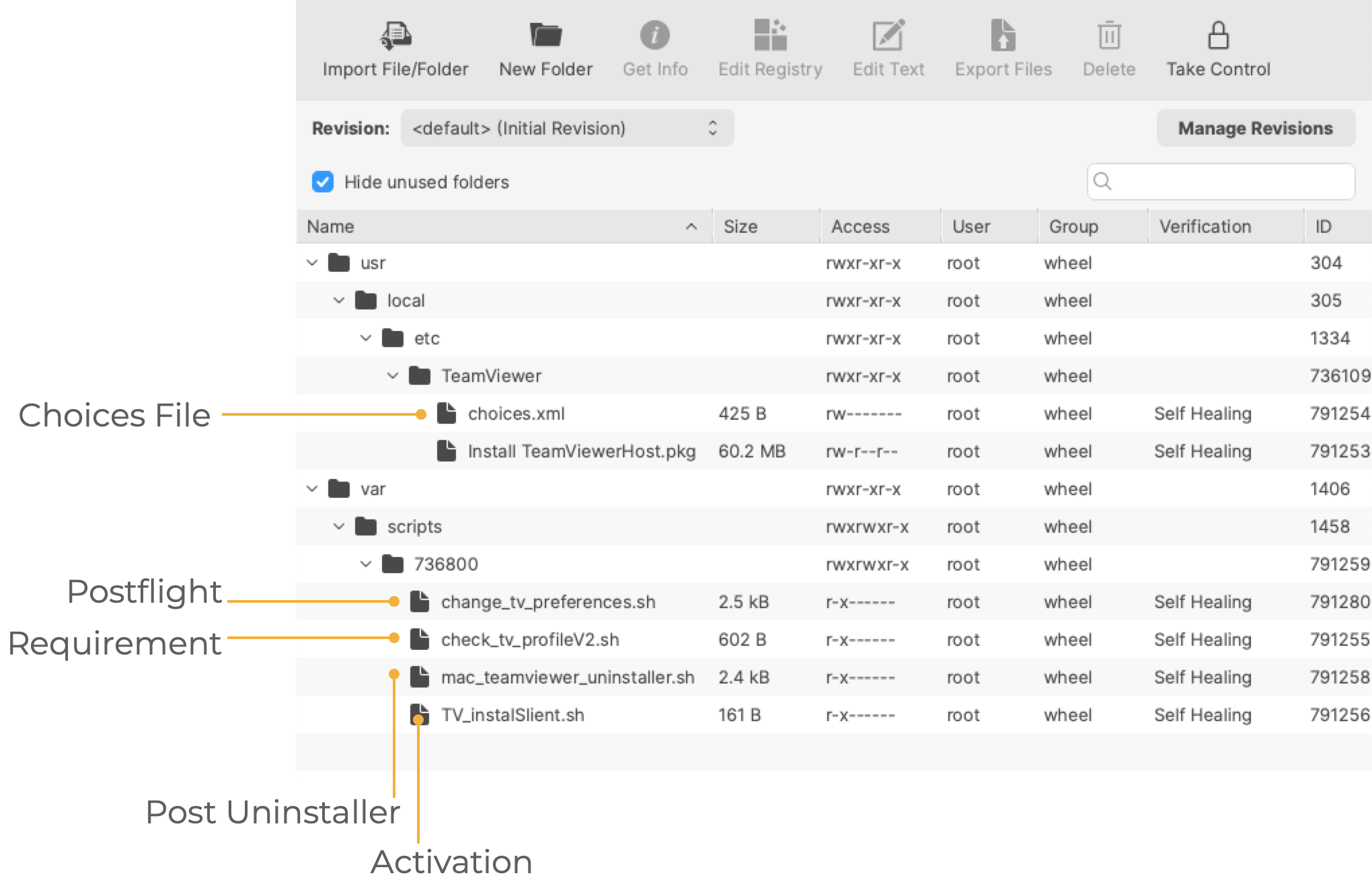
The choices.xml file is configured to install the .pkg silently.
Requirement Script:
Where the software is already installed and services are active, privacy settings payloads subsequently require the service of that software to be restarted after installation. The attached Fileset includes a Requirement Script that checks for profile installation before activating TeamViewer, preventing the need to restart the TeamViewer Host service.
The 'check_tv_profile.sh' script is designed to recognise one of the two provided Profiles and, once installed, allow activation of the Fileset. If Profiles with a different Profile ID are used instead of those supplied, the script settings will require alteration.
- Double-click the Fileset
- Select the 'check_tv_profile.sh' (located in a numbered subfolder in /var/scripts/)
- Choose Get Info > Executable view
The Launch Arguments show the two possible Payload IDs, one for the current Profile and one for the legacy profile. No changes are needed if you're only using one Profile. Add in the correct Fileset Profile ID if not using the provided ones.

Activation Script:
The script in this case is installing the PKG. Note that the script allows the specification of the 'choices.xml' file when executed.
#!/bin/zsh
installer -applyChoiceChangesXML /usr/local/etc/TeamViewer/choices.xml -pkg "/usr/local/etc/TeamViewer/Install TeamViewerHost.pkg" -target /
exit 0
Postflight
This script provides examples of configuring the TeamViewer Host. Three settings are configured, which may be removed/not changed by selecting the Postflight Script and deleting the file from the Fileset:
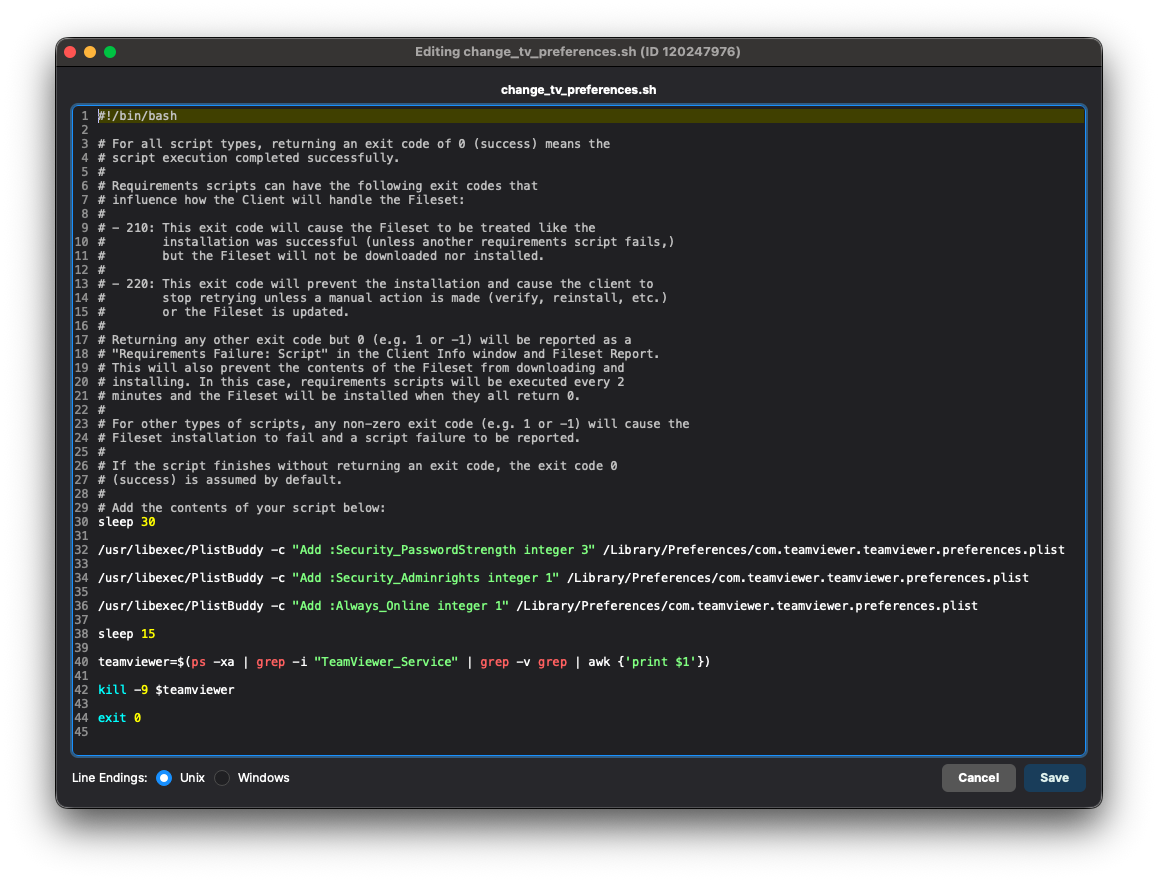
Possible Values:
| Setting | Value | Outcome |
| Security_Adminrights | 0 | Any user may change settings |
| 1 (Recommended) | Only administrators may change settings | |
| Security_PasswordStrength |
3 (Recommended) | No password - Will not allow other devices outside of the FileWave API to connect |
| 2 | 10 Character Password | |
| 1 | 6 Character Password | |
| 0 | 8 Character Password | |
| Always_Online |
0 | False: TeamViewer will not start again if it's forced to close |
| 1 (Recommended) | True: TeamViewer will start again if it's forced to close |
Setting No Password for password strength prevents anything other than FileWave from connecting to devices through TeamViewer Host.
Preference changes require TeamViewer to reload: Security_Adminrights is still used by the TeamViewer Host configuration shown here, but TeamViewer must restart or the device must reboot before a newly written preference is enforced. If standard users can still edit settings immediately after deployment, restart TeamViewer Host, verify the latest Fileset/Profile package is installed, then test again.
Post-Uninstallation Script:
The 'mac_teamviewer_uninstaller.sh' script uninstalls TeamViewer if an association or deployment no longer exists.
Updates
The software should auto-update to the latest version. If you would like the latest installer, you can download it from https://go.filewave.com/tvhost. If you're on a macOS system, the PKG will download. If you're on Windows, the EXE will download.
Don't forget to upgrade the full TeamViewer version on the Admin device.
Related Content
- TeamViewer macOS Mass Deployment Guide
- Latest TV Host (Download from macOS or Windows to get that platform's installer)
TeamViewer: Windows Client Setup
What
FileWave's TeamViewer integration requires endpoint prerequisites on each supported platform. In future versions, we may embed some of these prerequisites, but at this time, we err on the side of letting you control the elements. So, slightly more work but much greater control.
When/Why
We'll need to meet the prerequisites for Windows client devices for TeamViewer to work seamlessly. We'll need the following:
-
TeamViewer Pre-Requisites are met, ensuring that clients are set to allow remote control
-
TeamViewer Full Application installed on computers running FileWave Central (Native) or Anywhere (Web)
-
TeamViewer Host Application is installed on devices to be controlled.
The required TeamViewer Host installer is bundled in the below-provided Fileset and pre-configuration by way of a 'tvopt' file
The host version of TeamViewer does not provide the ability for users to control other devices.
How
TeamViewer Full Application
The computer used to view/control devices will require the full version of TeamViewer and may be downloaded from the TeamViewer site: https://www.teamviewer.com/en-us/download/
TeamViewer Client
The installer is actioned with scripts inside the provided Fileset, configured to ensure the installation is silent, including:
-
Disabling the prompt to configure Unattended Access
-
Removing the desktop icon
- Requires an Admin account to change settings
Current TeamViewer Fileset: Windows TeamViewer Host v15.70.3.fileset.zip
TeamViewer Host MSI download requires an account with TeamViewer. FileWave includes the MSI within the Fileset, but this should not be exported and redistributed. FileWave will aim to update the Fileset periodically to include newer versions of TeamViewer.
If there is a need to update before FileWave has provided a newer version, the download of the latest version of TeamViewer Host is only available publicly as an EXE:
If downloading the EXE, a new Fileset should be created using the EXE to upgrade.
Disassociation of the Fileset will uninstall TeamViewer Host with a pre-uninstallation script.
Customization
The Fileset provided has an example 'tvopt' file, which will customize the installation if left as is. If no customization is desired, this file may be removed. Alternatively, it is possible to upload an alternate 'tvpopt; file, preset as desired.
Example file 'example.custom.tvopt' highlighted in the image. Add a built file into the same directory called 'custom.tvopt' to override this; the 'example.custom.tvopt' may be left behind or removed.

Create Custom 'tvopt'
Follow the example instructions below to create a TeamViewer Host custom settings file for enforcement at the time of installation.
The TeamViewer Host app can be customized and secured to:
* Prevent users from connecting to their own devices remotely. Connections will only be possible via FileWave
* Blocking users from editing the settings by protecting them with a password.
For example, to secure the TeamViewer Host app and export its settings:
-
Install the TeamViewer Host component on a test device.
-
Launch it from the TeamViewer icon in the system tray, edit the settings and set the following options:
-
Security > Random password (for spontaneous access) > Password strength=Disabled (no random password)
-
Advanced > TeamViewer options > Changes require administrative rights on this computer
- Set Options/Confirm password fields
-
-
Click the Export button at the bottom of the Advanced options sections on the right. Save it as 'custom.tvopt'.
- Check Export user-specific settings as default for all users
-
Drag the 'custom.tvopt' file into the Fileset within the same directory as the current example file and installer MSI
-
Test before deploying en masse
TeamViewer also provides guidance here on mass deployment that may be helpful: https://community.teamviewer.com/English/kb/articles/39639-mass-deployment-on-windows
TeamViewer: Android EMM Client Setup
What
FileWave's TeamViewer integration requires endpoint prerequisites on each supported platform. In future versions, we may embed some of these prerequisites, but at this time, we erred on the side of letting you control the elements. So, slightly more work but much greater control.
When/Why
TeamViewer’s full application for Windows can be found here: https://www.teamviewer.com/en-us/download/windows/. For macOS, here: https://www.teamviewer.com/en-us/download/mac-os/. You will need to run that on the device that runs the FileWave Administrator console or WebAdmin. For your clients, the below steps discuss the deployment.
We'll need to meet prerequisites for Android client devices for TeamViewer to work seamlessly. We'll need the FileWave companion app to be upgraded to at least 14.7, and we'll want to deploy the TeamViewer QuickSupport and add-on applications as well.
| Component | Install? | Notes |
| Android EMM Companion App (FW Client App) | * Yes | Auto-deployed |
| TeamViewer QuickSupport App (Google Play Store) | * Yes | Details, which can be deployed as a FileWave Fileset: Play Store App - TeamViewer QuickSupport.fileset.zip |
| TeamViewer Add-On (Google Play Store) | * Yes | The add-on is required for device control (typing, screen clicks, etc)...and is specific to each type of Android device, reference the article linked to from the How section below for specifics about best practices for deployment |
FW Client App must be able to both resolve the server DNS name and reach the server since communication from this App is direct to the server, not via Google. Without this communication, the version of FW Client will not be updated on the server and the option to 'Open Remote Session' will be greyed out.
How
There are two elements we need to deploy to support TeamViewer on Android EMM devices:
- The TeamViewer QuickSupport App, which provides basic TeamViewer viewing capabilities, and
- The TeamViewer QuickSupport Add-On tool, which provides the ability to control the endpoint's cursor and keyboard
To keep the distribution simple and elegant, we'll probably want to build a structure that looks something this:
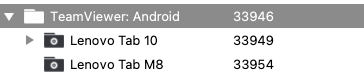
Note that you could also publish all of the apps needed to the Play Store Kiosk on the devices as well, but we feel that would be pretty cluttered for the users of the devices, albeit simpler for the FileWave admin.
In our structure, the top-level group is just a manual group, and we will assign the Fileset (Payload) for the TeamViewer QuickSupport app here. Below that top-level group we'll create groups for each type of Android device we have. The add-on is device-specific, therefore we will create a smart group for each device type based on the Device Product Name field.
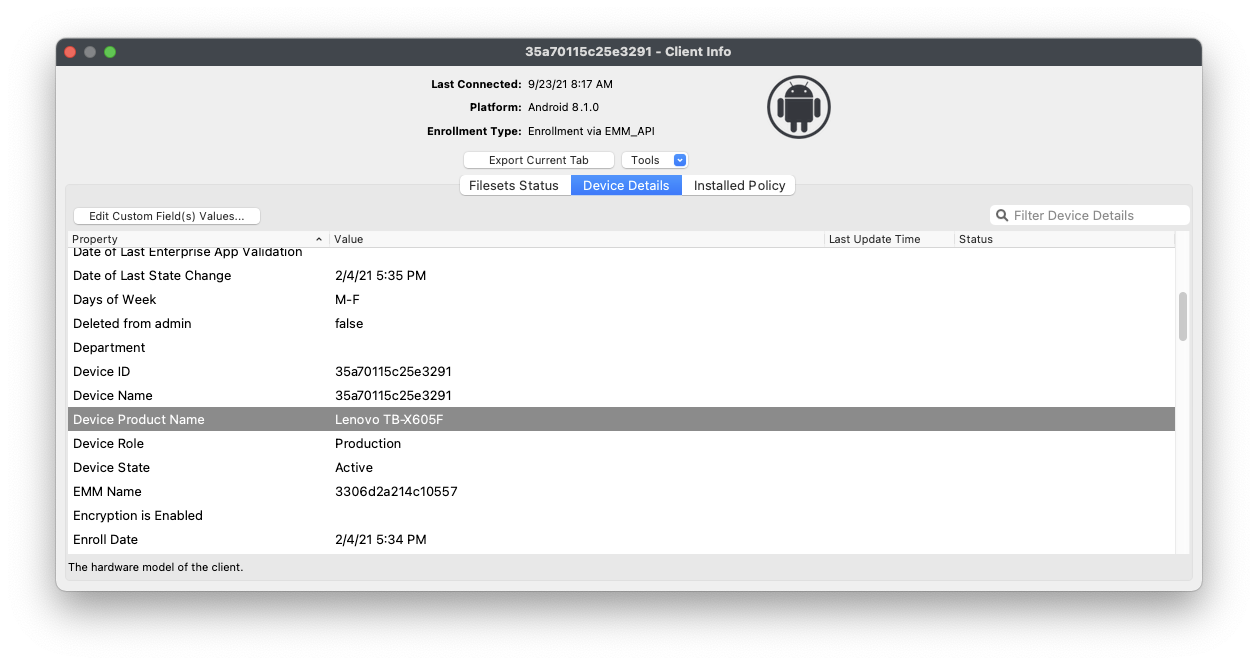
In the case of the Lenovo M10 tablet, the product name is "Lenovo TB-X605F", so we created a Smart Group based on Device Product Name matching that exact name. Because this group is a smart group all M10 tablets will automatically be included and, therefore will have the QuickSupport app assigned from the group above, which addresses our first pre-requisite.
Remember, you can duplicate a smart group by right-clicking and choosing "Duplicate"...this makes it much simpler to add multiple similar smart groups.
Now, for the Add-On installation...it is a bit more complicated because we don't know which add-on fits our device best. In this case, it is best just to cheat and let the TeamViewer QuickSupport app recommend the add-on to install on a sample device. In our case, it recommends an add-on for the x705F, found here: https://play.google.com/store/apps/details?id=com.teamviewer.quicksupport.addon.lenovo_tb_x705f
So, we'll now create a Fileset for that app. and assign it to the appropriate smart group. Then, rinse and repeat for each device type, which hopefully won't be too many.
There is also a Universal Add-On available, but at least in our testing, the device-specific add-ons worked best.
On initial setup, the option for starting a remote control session for an Android can be delayed to allow synchronization between FileWave/Google. This is only at the setup of the device though and should complete within 15-30 minutes maximum.