
How to Import a Content Pack
What
Content Packs combine prebuilt FileWave components for a particular task, such as reporting or checking device health. The components and any setup required depend on the pack you choose.
When/Why
Whenever we want to make use of a content pack to give us a helping hand, we'll need to import the content into our FileWave system.
How
In FileWave 16.1.0 and later, connect FileWave Central to the intended Server with an authorized administrator account, then open Assistants > Content Packs. This is the built-in import workflow; older manual import instructions in individual pack articles apply to the versions those articles specify.
Select a Content Pack on the left. Read its description and open More details for the pack-specific instructions; use Info beside a component to review it before importing. Check the displayed Version and Released date, then select only the components you need. In FileWave 17.0, select Linux if the pack offers Linux components you want to import. Depending on the pack, these can include Filesets, Custom Fields, reports, or Smart Groups. Pack names and descriptions can also appear in translation.
Before re-importing a pack, review the existing reports, dashboards, Custom Fields, local customizations, and anything that depends on them. Do not overwrite a customized component unless you intend to replace it with the pack version.
Click Import. Review any conflict prompts for the selected components, then review the completion details for errors.
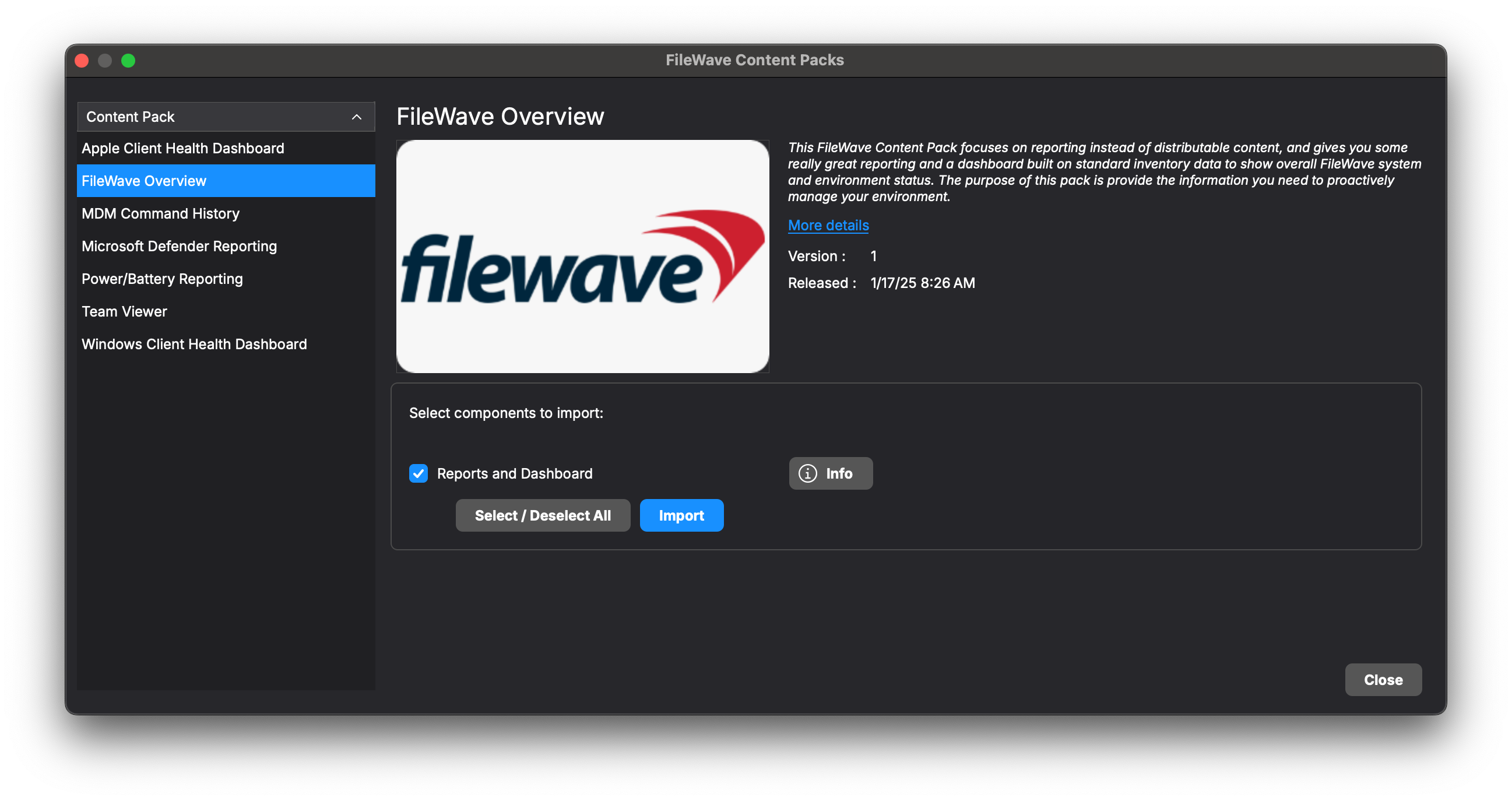
After import, locate the selected components in FileWave and follow the pack-specific configuration and verification instructions. An import is not proof that the pack is ready for your environment or that devices have supplied the data its reports need. Pack updates are not applied automatically to an earlier import. Compare the pack version and completion details so you can identify what actually needs updating. Re-importing can create duplicate Custom Fields; do not delete an earlier import simply to retry.
Choosing a Linux Content Pack in FileWave 17.0
Linux Client Health Dashboard is the Linux counterpart to the Windows Client Health Dashboard. Five Custom Fields report LUKS disk encryption, domain membership through realmd or sssd, dpkg locks and database health, failed systemd units, and the FileWave Client’s Heartbeat Interval.
The Grafana dashboard shows these fields alongside the kernel version, pending apt updates, the last Client upgrade, disk space, and the last check-in. Problem tiles count only Clients seen in the last 30 days. A separate tile flags recently seen clients whose last software update scan was more than a week ago.
For other tasks, choose the pack that matches what you want to do:
- Example Reports includes Linux OS reports, with examples for Debian releases.
- FileWave Overview includes Linux Clients in cross-platform reports.
- TeamViewer includes a Linux Fileset for TeamViewer Host and covers Linux in its Custom Fields, reports, and dashboard.
- Power/Battery Reporting shows battery health on Linux laptops and display and system sleep settings on GNOME desktops.
Updating a Grafana dashboard in FileWave 17.0 and later
When re-importing a Content Pack whose Grafana dashboard already exists, choose Skip to leave that dashboard unchanged, or Overwrite to replace it with the pack version. FileWave 17.0 corrects the repeated-import behavior that created another copy instead of finding the existing dashboard. These choices apply to the dashboard conflict; review other component prompts separately.
After importing, open the Grafana dashboard in FileWave Anywhere and check that the expected dashboard is present without an additional copy. If you chose Skip, confirm that the existing dashboard is unchanged. If you chose Overwrite, check the updated dashboard and its reports. If duplicate dashboards were already present, review them and their dependencies before removing anything.
No comments to display
No comments to display