
Inventory Items in Profiles
What
- Each Inventory Items has an Internal Name, including Custom Fields which provide extended inventory
- Use an inventory item’s Internal Name in a supported Apple profile text field, enclosed in percent signs, for example
%device_product_name%. For Custom Fields, use the profile prefixcustom_field., for example%custom_field.asset_tag%.
When
Start with an MDM-enrolled Apple device and confirm that its inventory contains the value you intend to use. A Custom Field must be associated with that device and populated before you rely on it in the profile. See Using Parameters in Apple iOS/macOS Profiles for supported variables and the distinction between values resolved by FileWave and variables resolved locally by macOS.
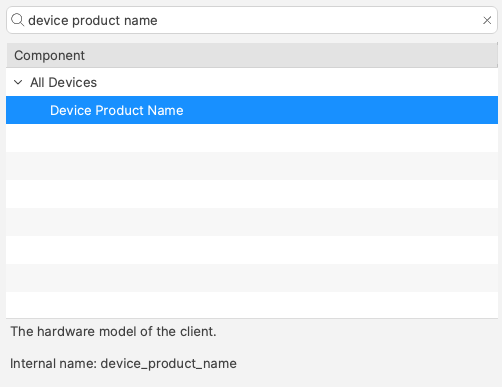
Internal Name of an Inventory Item may be located from the Inventory Query Editor. Example shows the Internal Name: ‘device_product_name’
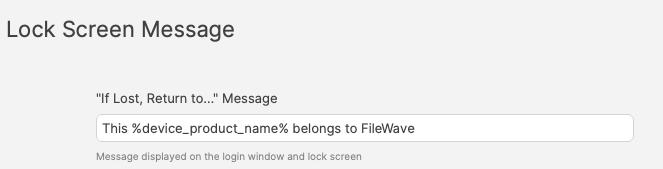
This may be added into a Profile, effectively customising the Profile per device or user:

Custom Fields
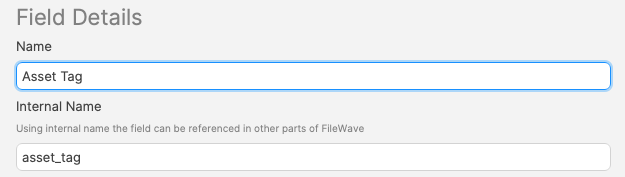
Associated Custom Fields may also be used with Payloads settings of Profiles. Extending the above example, consider a Custom Field for Asset Tag:
Custom Field Definition
Profile Payload
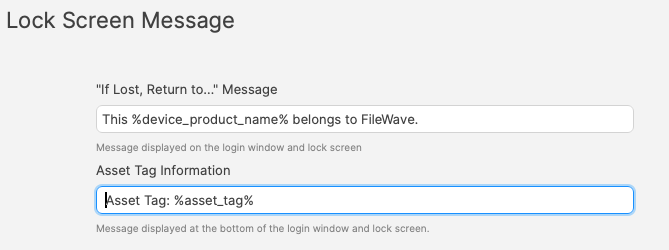
Lock Screen

Improvement
When referencing a Custom Field in a Profile Payload, it could be referenced in one of two ways. From the above example, it could be either:
- %asset_tag%
- %custom_field.asset_tag%
The additional prefix indicates more clearly that this is a Custom Field Inventory Item. If there was an Inventory Item with a matching name provided by FileWave, the first item in the list would report the provided Inventory Item value for the device and not the Custom Field.
For demonstration, imagine creating a Custom Field called 'My Device Product Name' with Internal Name: device_product_name.
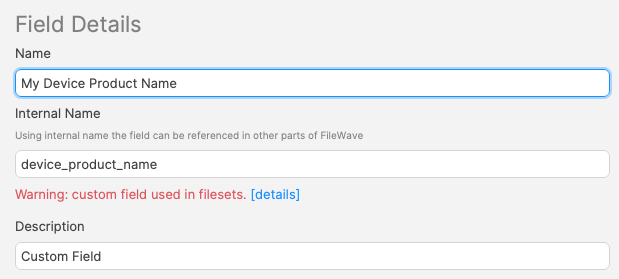
There are now two Inventory Items with the Internal Name: device_product_name:
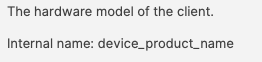
and
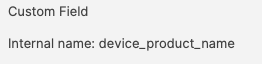
With the values:
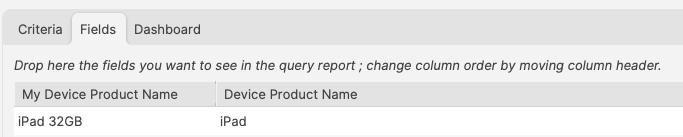
For the same-name example, %device_product_name% selects built-in inventory, while %custom_field.device_product_name% selects the Custom Field named My Device Product Name. The Lock Screen Message screenshot below uses a different Custom Field, %custom_field.asset_tag%, alongside the built-in product name:
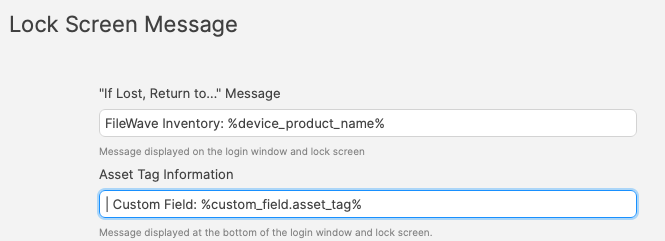
In the lock-screen result below, iPad is the built-in product name and iPad001 is the custom asset tag. The unprefixed product-name token does not select the Custom Field named My Device Product Name.

To prevent confusion with overlapping Inventory Items between Custom Field and built-in Inventory, always consider using the prefix for Custom Fields
User Customisation
Although FileWave doesn't manage users, if users are associated with devices, this extends the ability to customise Profiles for users.
User details from enrolment may be used, but to extend beyond this, LDAP servers set for extraction can greatly increase the Inventory Items available for Parameters via LDAP Custom Fields.
An example of Profile customisation for users:
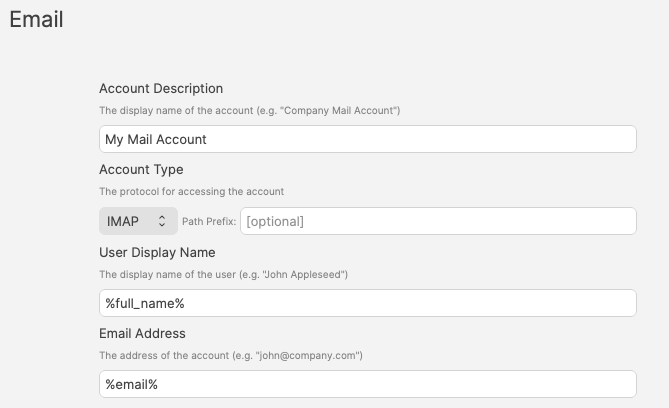
One Profile can therefore be used for multiple devices, tailoring the Payload to the users of those devices. After deployment, check the resolved value on a test device. Changing an inventory or Custom Field value alone does not update an already-installed profile. If devices need the new value, review the removal and reinstallation consequences in Profile Payload Planning before reinstalling the profile.
No comments to display
No comments to display