
FileWave Boosters Improved Server Message Routing
What
FileWave 11 introduced Booster Routing to reduce direct Client-to-Server message traffic by routing messages through a Booster. This does not route every Client connection through a Booster: Clients still need the HTTPS connections used for inventory and profile delivery. Do not block all direct Server access on the assumption that this setting replaces it; see What are Server Messages and why do I want them? for the communication boundaries and network-planning reference. With FileWave 15.0, the internal notification system switched entirely to NATS, replacing ZMQ; NATS provides built-in security features and a more flexible notification transport.
When/Why
FileWave 15.3 can now use NATS as the communication protocol for all maintenance messages between client and server. Fileset delivery still uses the classic protocol, but messages like Fileset status or check-in now use the lightweight and fast delivery mechanism offered by NATS.
How
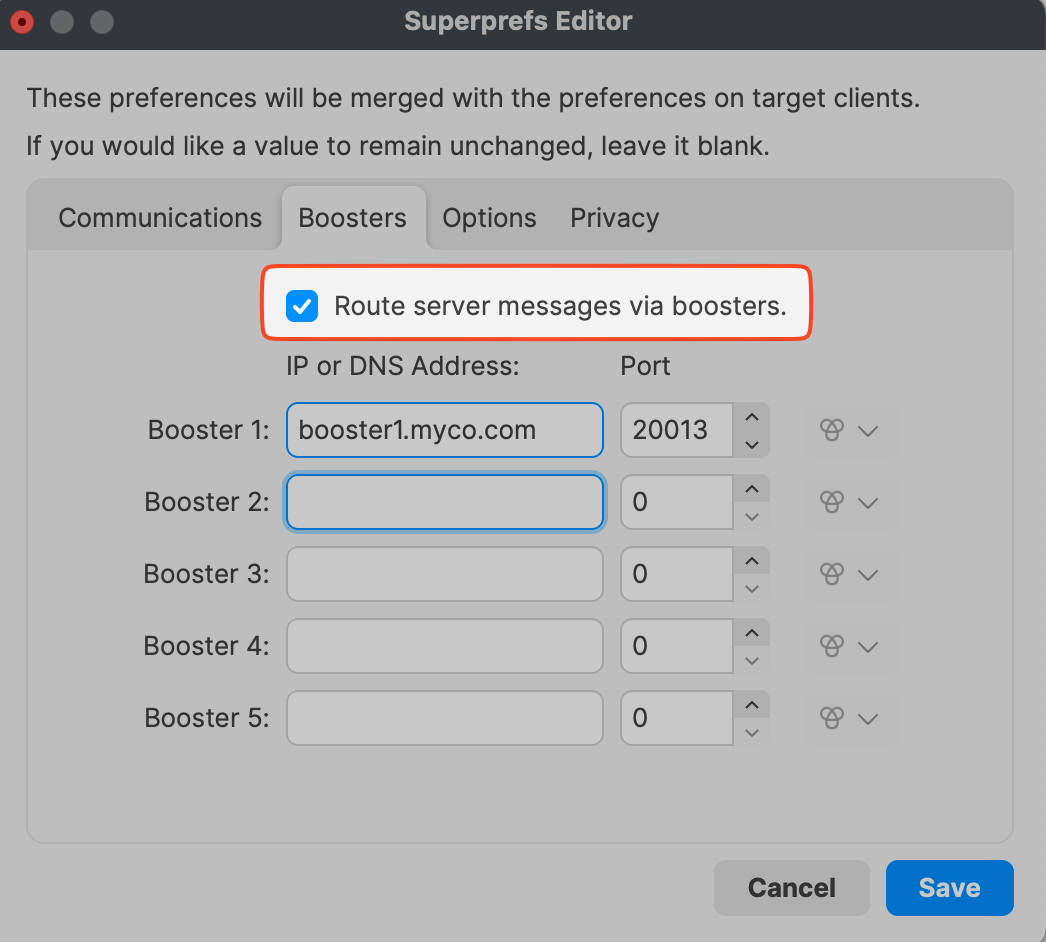
Please review the Boosters documentation. If you manage Windows or macOS systems in either a FileWave-hosted or on-premise environment, one or more Boosters are optional but often recommended, especially when many clients share a LAN or VPN path. Boosters can minimize server and WAN traffic by caching Filesets and application installers closer to clients; in hosted deployments this also reduces traffic from the hosted FileWave server. For Windows devices, Boosters can also cache Microsoft OS updates and patches. For Apple OS updates and upgrades on macOS, iOS, and iPadOS, use Apple Content Caching instead. For existing Clients, enable Route server messages via boosters. in a Superprefs Fileset and set the intended Booster addresses. Deploy it to a test device and confirm the Fileset reaches and activates on that Client; saving the preferences locally is not enough. An unset (dash) routing checkbox leaves that preference unchanged. For new Client installations, include those settings in the custom Client installer: use Central's integrated builder for Server 16.4.0 and later, or Custom FileWave Client for earlier Servers.
No comments to display
No comments to display