FileWave Early Access Program
Start with the Early Access overview, then use the related articles to build custom clients or enable Beta package URLs for self-managed Early Access servers.
- What is the Early Access Program?
- Enable Early Access (Beta) Package URLs
- Building Custom Clients During Early Access
- FileWave Version 16.4.0
What is the Early Access Program?
Description
The FileWave Early Access Program provides supported pre-release FileWave resources for customers who need to evaluate, test, or prepare for upcoming FileWave releases before general availability.
Early Access and Beta refer to the same testing channel in this chapter. FileWave Central may show the channel as BETA.
Once a release becomes generally available, Early Access articles and resources are moved to their standard locations in the Knowledge Base and normal release notifications are distributed.
What is included?
- Early Access download and package resources for the upcoming FileWave release.
- Custom client build links for macOS and Windows clients during the Early Access window.
- macOS and Windows Client Upgrade Fileset guidance for 16.4 Early Access client upgrades, especially when older clients need a bridge into the newer automatic/integrated upgrade path.
- Server-side Beta package URL configuration for self-managed Early Access environments, starting with FileWave 16.4.0.
Fully supported builds and Early Access benefits
Builds referenced in this chapter have passed FileWave QA and are supported by FileWave for Early Access testing. Early Access is useful when you need to:
- Evaluate new features sooner: Test upcoming FileWave capabilities before they become generally available.
- Prepare for Day 1 OS support: Validate operating-system support and deployment workflows before broader rollout.
- Test safely: Use sandbox, pilot, or non-production environments before production deployment.
- Work with FileWave: Provide feedback during Early Access so issues can be resolved before general availability.
- Address targeted support cases: Customer Technical Support may direct you to an Early Access build when it addresses a specific issue or operational need.
Hosted customers
If you are a Hosted FileWave customer and want your server included in the Early Access program, open a Technical Support case and request to be added. FileWave Operations will schedule the hosted-server upgrade and communicate the Early Access upgrade timing.
Self-managed customers
Self-managed customers can use the articles in this chapter to prepare servers and clients for Early Access testing. Server-side configuration changes require shell access to the FileWave Server.
Early Access articles
Support
If you encounter issues during Early Access, contact Customer Technical Support through your standard support channels. Your feedback helps improve the release before general availability.
Enable Early Access (Beta) Package URLs
Description
Starting with FileWave 16.4.0, self-managed Early Access customers must enable Beta package URLs on the FileWave Server before using the Early Access upgrade mechanisms for FileWave Central, Server, Clients, Boosters, or Imaging Virtual Servers (IVS). Early Access, also shown as Beta in FileWave Central, allows package sources that use the server runtime environment to access Beta packages, including integrated package and upgrade sources.
Use this only for FileWave Early Access/Beta testing when directed by FileWave. Early Access packages are intended for validation before general availability.
Plan Central, Server, Client, Booster, and IVS upgrades
Enabling Beta package URLs means the environment is opting into Early Access/Beta upgrade sources, not just changing the label shown in Central. Enable it before starting the Early Access upgrade sequence. After the setting is loaded, FileWave Server uses Early Access/Beta package URLs. Once the Server and FileWave Central are upgraded to 16.4, Central can show the Beta state, Boosters become eligible for Beta upgrades, integrated Client upgrades can target Beta packages, and the 16.4 IVS upgrade workflow can use the matching Early Access package source.
Client upgrades during 16.4 Early Access
At least during the FileWave 16.4 Early Access cycle, keep the macOS and Windows Client Upgrade Filesets in your client-upgrade plan. The newer integrated client upgrade path depends on the client already being at the newer upgrade baseline.
For example, clients running FileWave Client 16.2 need a Client Upgrade Fileset path first. They do not appear in Software Updates > Client Upgrades, and an empty view does not mean they are current. Without a 16.4 Client Upgrade Fileset, you would first deploy a 16.3 Client Upgrade Fileset and then let the automatic/integrated upgrade path continue from there.
The 16.4 macOS and Windows Client Upgrade Filesets are designed to return requirements not met on devices that are already running FileWave Client 16.3 or later, so they can act as a bridge for older clients without replacing the integrated upgrade behavior for clients that already meet the newer baseline.
Schedule the Beta target from the right-click menu. Select the eligible client or group in Client Upgrades, right-click it, and choose Schedule Beta Upgrade. The toolbar scheduling action is for the non-Beta target.
See Upgrading FileWave Clients for sanitized examples of an eligible client, the misleading empty state, and the Beta scheduling menu.
The Client Upgrade Fileset also remains a support-guided fallback during Early Access testing. If the integrated client upgrader does not behave as expected, FileWave Support may direct you to import the Client Upgrade Fileset and adjust its requirement check for a specific recovery path.
After a FileWave Server upgrade, compatible Boosters are automatically scheduled for upgrade. By default, that automatic Booster upgrade is scheduled 7 days after the Server upgrade. For Early Access testing, set the automatic Booster upgrade delay to 0 days before upgrading the Server if you want Boosters to upgrade immediately instead of waiting the default week.
In FileWave 16.4.0 and later, that delay is controlled in FileWave Central > Preferences > Upgrades. The setting is evaluated when the Server upgrade schedules Booster upgrades, so changing it afterward does not retroactively reschedule Boosters that were already queued.
For the Booster behavior and screenshots, see Upgrading Multiple Boosters.
Enable Early Access package URLs
- On the FileWave Server, edit the environment file:
/usr/local/etc/filewave/.env- Add this line on its own line:
RUNTIME_ENVIRONMENT=beta- Save the file.
- Restart FileWave Server so the runtime environment is loaded:
sudo fwcontrol server restartContinue to the correct upgrade guide
Do not expect the BETA label before the upgrade. The BETA indicator is new in FileWave Central 16.4. Enabling the Beta package URLs on an earlier Server makes the Early Access packages available, but the existing Central application cannot display that new label.
- On-premises/self-managed: After enabling the Beta package URLs, follow Upgrading your On-Premise FileWave Server. It upgrades the Server first and then FileWave Central before continuing with Boosters, IVS appliances, Clients, Kiosk, and enrollment packages.
- FileWave-hosted: FileWave Operations enables the Early Access channel and upgrades the hosted Server. After Operations confirms completion, follow Your Hosted FileWave Server Has Been Upgraded—What Are Your Next Steps?, beginning with the FileWave Central upgrade.
Confirm Beta after Central is upgraded
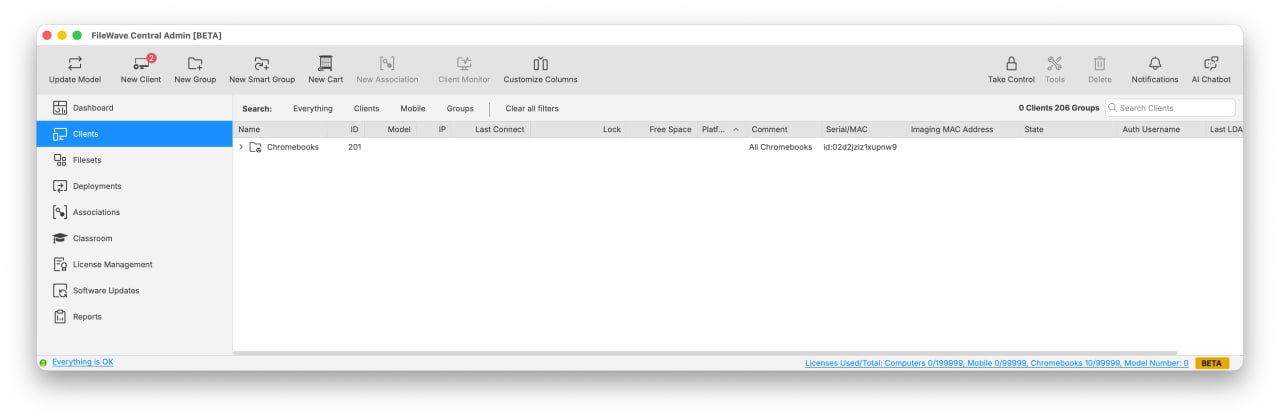
After FileWave Central is upgraded to 16.4 and connects to a Server using the Beta runtime environment, Central shows BETA in the window title and bottom-right status area. Use this as the post-upgrade confirmation before scheduling Beta Client, Booster, or IVS actions. Clicking the BETA indicator opens this article.
Disable Early Access package URLs
- Remove this line from
/usr/local/etc/filewave/.env:
RUNTIME_ENVIRONMENT=beta- Save the file.
- Restart FileWave Server again:
sudo fwcontrol server restartRelated articles
Notes
- Early Access and Beta refer to the same testing channel in this context.
- The server restart is required after enabling or disabling the flag because FileWave Server reads the runtime environment during startup.
- The short link for this article is https://go.filewave.com/beta.
Building Custom Clients During Early Access
Description
Use this article to build custom macOS and Windows FileWave Client enrollment installers while participating in the FileWave Early Access Program. Early Access, also called Beta, provides supported pre-release packages for customers validating an upcoming FileWave release.
Early Access baseline: The Early Access program now assumes FileWave Server 16.4.0 or later. All current and future Early Access releases build custom enrollment packages directly in FileWave Central. External Early Access custom-client builders are no longer part of this workflow.
Enable the Early Access package channel first. Self-managed customers must complete Enable Early Access (Beta) Package URLs on the FileWave Server. FileWave Operations handles this server-side configuration for hosted environments enrolled in Early Access. After the Server and FileWave Central are upgraded to 16.4, confirm that Central shows BETA before building or scheduling Beta packages.
Choose the correct package or upgrade path
| Task | Use this workflow |
|---|---|
| Install a new client, reinstall a client, or test an enrollment installer | Build and download the custom package from FileWave Central > Preferences > Mobile. |
| Upgrade an enrolled FileWave Client already running 16.3.0 or later | Use Software Updates > Client Upgrades and schedule the Beta target from the right-click menu. |
| Upgrade an enrolled FileWave Client earlier than 16.3.0 | Use the applicable macOS or Windows Client Upgrade Fileset to reach the integrated upgrade baseline. |
Build an Early Access enrollment package in Central
- After the Server and FileWave Central are upgraded to 16.4, confirm that Central shows BETA in the window title and bottom-right status area.
- Open FileWave Central > Preferences > Mobile.
- Select macOS or Windows.
- Select Show settings and review the enrollment-package configuration.
- Select Build macOS client package or Build Windows client package.
- After the build completes, use the corresponding Download button to obtain the installer.
- Enable Keep the package up to date when FileWave should rebuild the enrollment package after future Server upgrades.
These are enrollment packages, not the upgrade mechanism for enrolled clients. Use them for new installations, reinstalls, and controlled deployment testing. Do not deploy a custom PKG or MSI over an already enrolled client as its upgrade path.
Upgrade existing clients during Early Access
Clients running FileWave 16.3.0 or later
Use Software Updates > Client Upgrades. The FileWave 16.4 Upgrade Filesets return requirements not met on these clients so the legacy Fileset does not replace the integrated upgrade mechanism.
Schedule the Beta target from the right-click menu. Select the eligible client or group, right-click it, and choose Schedule Beta Upgrade. The toolbar scheduling action targets the non-Beta upgrade.
Clients earlier than FileWave 16.3.0
Use the applicable macOS or Windows Client Upgrade Fileset to bring the client to the integrated upgrade baseline. Clients earlier than 16.3.0 do not appear in Client Upgrades, so All Clients Up to Date does not account for them. If a FileWave 16.4 Upgrade Fileset is unavailable for the legacy version being upgraded, deploy the FileWave 16.3 Upgrade Fileset first, then continue with the integrated workflow.
See Upgrading FileWave Clients for the complete inventory audit, Upgrade Fileset bridge, and illustrated scheduling workflow.
The Upgrade Fileset may also be used as a support-directed recovery path during Early Access testing. Do not modify its requirement checks unless FileWave Support provides a specific recovery procedure.
Related articles
- What is the Early Access Program?
- Enable Early Access (Beta) Package URLs
- Upgrading FileWave Clients
Support
If you encounter issues or require assistance, contact Customer Technical Support through your standard support channels. Feedback during Early Access helps FileWave validate upgrade and enrollment workflows before general availability.
FileWave Version 16.4.0
Early Access release — enable the Beta package channel before upgrading. FileWave 16.4.0 is currently an Early Access release. Complete the applicable setup below before using the 16.4 upgrade mechanisms:
- On-premises/self-managed Server: Follow Enable Early Access (Beta) Package URLs on the existing FileWave Server first, then follow Upgrading your On-Premise FileWave Server for the complete Server and component upgrade sequence. After the Server and FileWave Central are upgraded to 16.4, confirm that Central shows BETA before scheduling the Beta Client, Booster, or IVS actions.
- FileWave-hosted Server: If your environment is enrolled in the Early Access program, FileWave Operations applies the Early Access configuration and upgrades the hosted Server. Hosted customers do not have SSH access, so there is no customer-side Server configuration step. After Operations confirms the Server upgrade, follow Your Hosted FileWave Server Has Been Upgraded—What Are Your Next Steps?, beginning with the FileWave Central upgrade. Once Central 16.4 connects to the upgraded Server, confirm that it shows BETA before continuing with the remaining Beta upgrade actions.
Do not treat the downloads or an available upgrade action by themselves as proof that the environment is using the Early Access package channel.
The FileWave endpoint management suite enables you to manage your devices wherever they are, wherever you are, whatever they are—all in one platform. FileWave 16.4 is a lifecycle automation and platform modernization release focused on making upgrades, deployments, and day-to-day administration safer and less manual. Building on the upgrade foundation introduced in FileWave 16.3, this release moves supported FileWave Client upgrades into Software Update with monitoring, retry, rollback, and batch controls; adds more resilient automatic Booster upgrades; and introduces Central-managed Imaging Virtual Server (IVS) upgrades for on-premises FileWave Server deployments. FileWave 16.4 also improves performance at scale, strengthens Fileset upload validation, integrates macOS and Windows agent package generation into Central, expands Deployment views and options, adds a Deployments API, and continues administrator experience improvements such as localized server messages and a simplified deployment workflow.
Across managed platforms, FileWave 16.4 broadens visibility and control for mixed fleets. Apple management gains visionOS and Apple Vision Pro support, Apple School and Business Manager API integration, the Profile Compatibility Report, richer MDM and DDM Fileset Status details, import and export for DDM declarations, Managed Migration Assistant, expanded DDM settings for Siri, keyboard behavior, Apple Intelligence, External Intelligence, and Migration Assistant, plus VPP license and synchronization improvements. Inventory now reports application architecture for macOS and Windows, Android EMM adds new system-update, compliance, per-app update, and credential-provider policy controls, and the release removes older legacy components such as pre-iOS 12 code and the legacy VPP API. Together, FileWave 16.4 continues the move toward more automated, observable, and resilient endpoint management while setting a minimum direct-upgrade baseline of FileWave 16.0.
FileWave Official Version Support
FileWave supports the two latest major versions at any time. For example, if the current version is 16.4.0, we support versions 16.4.x and 16.3.x. Major releases occur roughly every quarter.
What does “officially support” mean?
We will investigate and patch significant issues in these versions. We do not produce patches for versions older than N-1, focusing instead on current versions and future improvements. If an issue is found in an older version, remediation will be in the form of an upgrade or a patch to a more recent version.
You can still contact our support teams about earlier versions. They will assist you to the best of their ability but won’t escalate tickets to our development teams. Upgrading is recommended to access the latest features and bug fixes.
Compatibility
A Note on Compatibility
A note on the Compatibility charts: There are several states of compatibility for FileWave clients:
- "Fully Tested by QA" indicates that we have run QA regression tests against these operating system versions, and they are fully supported.
- "Expected to Work" Not being on the fully tested by QA list (such as macOS 13 or 14) does not mean that platform is not supported...it just means we did not actively test against it, but we do expect it to function. Support of any issues experienced specifically on these platforms would be considered on a case-by-case basis (but these cases are exceedingly rare.)
- "Legacy" versions mean that we don't test, but we do provide a retro-version of a client so that the device can still report in but as FW Server changes there may be challenges to these working. There is NO support for these platforms beyond the availability of the older client, and in almost all cases these are for OSes that are no longer supported by the OS vendor in question.
- Lastly, items do fall out of support, such as Windows XP and the older Android APK client as examples, but we always include these items in our release notes.
An additional note on third-party software inclusion, such as TeamViewer:
- Partnerships we have with third party providers have their own set of system requirements for those released applications. We test against their most recent versions, and support of those applications is limited to third-party vendor specifications.
FileWave Server Platform Support
 Fully Tested by QA
- macOS 15 and 26 (Intel and Apple Silicon)
- Debian 13.2 x86_64 (Note that any Debian 13.x is expected to work, and applying security updates may move you to a higher version.)
Expected to work
- macOS 13 and 14 (Intel and Apple Silicon)
- Debian 12.x (x86_64)
Virtual Appliances
- Hyper-V - The images are available as Generation 2
- VMware ESX - The images require vmx-19 support which means VMware vCenter 7.0 Update 2 is the minimum version. ( https://knowledge.broadcom.com/external/article?legacyId=2007240 )
- VMware Fusion
- VMware Player and Workstation
- VirtualBox
Important FileWave Server upgrade requirement
FileWave Server upgrades that include PostgreSQL database changes must follow a path where each step supports at least one PostgreSQL version from the previous step. For more detail and examples, see FileWave Server upgrade paths and PostgreSQL migrations.
The PostgreSQL overlap points are:
• FileWave 13.3.1 through 14.7.2 include PostgreSQL 12.
• FileWave 16.0.x through 16.2.x include PostgreSQL 12 and PostgreSQL 17.
• FileWave 16.3.x and 16.4.x include PostgreSQL 17 and PostgreSQL 18.
Recommended upgrade path from older versions:13.3.1–14.7.2 → 16.0.x–16.2.x → 16.3.x or 16.4.x
If your server is already running FileWave 16.0.x, 16.1.x, or 16.2.x, you can upgrade directly to FileWave 16.3.x or 16.4.x because those releases overlap on PostgreSQL 17; if your server is running a version earlier than 16.0.0, upgrade first to a release in the 16.0.x–16.2.x range, then continue to FileWave 16.3.x or later.
The minimum memory requirement for FileWave Server is 8GB.
FileWave Clients Platform Support

Fully Tested by QA
- macOS 15 and 26 (Intel and Apple Silicon)
- Windows 11 (Pro/Enterprise, version 24H2 and newer, x64)
- Windows Server 2022 (x64)
Expected to work
- macOS 13 and 14 (Intel and Apple Silicon)
- Windows 10 (Pro/Enterprise, version 21H1 and newer, x64)
- Windows 10 (Education, version 21H1 and newer, x64)
- Windows 11 (Education, version 23H2 and newer, x64)
- Windows 10 Enterprise LTSC (version 2021 and newer, x64)
- Windows 11 Enterprise LTSC (version 23H2, x64)
- Windows Server 2025 (x64)
Devices running macOS 27 beta can be enrolled for testing.
Note about LTSB/LTSC: Microsoft Long Term Service Channel
Legacy
- macOS 10.11 → End of Life due to OpenSSL age
- macOS 10.12 → Legacy Version 14.10.2
- macOS 10.13 → Legacy Version 14.5.4
- macOS 10.14 → Legacy Version 14.8.0
- macOS 10.15 → Legacy Version 15.0.1
- macOS 11 → Legacy Version 15.5.2
- macOS 12 → Legacy Version 16.2.5
FileWave Mobile Clients Platform Support
 Fully Tested by QA
- iOS 18, 26
- iPadOS 18, 26
- tvOS 18, 26
- visionOS 26
- Android 8 and above (EMM Client)
- Chromebook
Expected to work
Currently Apple is investigating an issue enrolling iOS 16 or older via ADE/DEP. Enrollment via profile works.
- iOS 14, 15, 16, 17
- iPadOS 14, 15, 16, 17
- tvOS 14, 15, 16, 17
- visionOS 1.1, 2
Legacy
- iOS 13 → Legacy Version 15.0.1
- iOS 10, 11, 12 → Legacy Version 13.1.5
FileWave Central (Native) Platform Support
Fully Tested by QA
- macOS 15 and 26 (Intel and Apple Silicon)
- Windows 11 (Pro/Enterprise, version 21H2 and newer, x64)
Expected to work
- macOS 13 and 14 (Intel and Apple Silicon)
- Windows 10 (Pro/Enterprise, version 21H1 and newer, x64)
- Windows 10 (Education, version 21H1 and newer, x64)
- Windows 11 (Education, version 21H2 and newer, x64)
FileWave Booster Platform Support

Fully Tested by QA
- Debian 13.2 x86_64 (Note that any Debian 13.x is expected to work, and applying security updates may move you to a higher version.)
- macOS 15 and 26 (Intel and Apple Silicon)
- Windows 11 (Pro/Enterprise, version 24H2 and newer, x64)
- Windows Server 2022 (x64)
Expected to Work
- Debian 12.x (x86_64)
- macOS 13 and 14 (Intel and Apple Silicon)
- Windows 10 (Pro/Enterprise, version 21H1 and newer, x64)
- Windows 10 (Education, version 21H1 and newer, x64)
- Windows 11 (Education, version 23H2 and newer, x64)
- Windows Server 2025 (x64)
Virtual Appliances
- Hyper-V - The images are available as Generation 2
- VMware ESX - The images require vmx-19 support which means VMware vCenter 7.0 Update 2 is the minimum version. ( https://knowledge.broadcom.com/external/article?legacyId=2007240 )
- VMware Fusion
- VMware Player and Workstation
- VirtualBox
FileWave Imaging Virtual Server Platform Support
The FileWave Imaging Virtual Server (IVS) is a special appliance that provides imaging support for Windows 11 UEFI and non-UEFI devices. Windows 10 imaging is expected to work.
Fully Tested by QA
- Debian 13.2 x86_64 (Any Debian 13.x release is expected to work, and applying security updates may move the appliance to a later Debian 13.x version.) FileWave IVS 16.3.0 and later require Debian 13.
Virtual Appliances
- Hyper-V - The images are available as Generation 2
- VMware ESX - The images require vmx-19 support which means VMware vCenter 7.0 Update 2 is the minimum version. ( https://knowledge.broadcom.com/external/article?legacyId=2007240 )
- VMware Fusion
- VMware Player and Workstation
- VirtualBox
Features and Updates in this Release
FileWave Management Suite Changes
Performance improvements
FileWave 16.4 includes a broad range of performance improvements across the platform, focused on reducing unnecessary processing and improving the efficiency of common operations.
As part of ongoing work to modernize the FileWave codebase, several legacy workflows have been simplified and optimized. This reduces database load, lowers resource consumption, and improves responsiveness throughout the system.
Areas that received particular attention include Model Update, Smart Group evaluation, and other server-side processes that operate at scale. In many cases, operations that previously required large numbers of individual database transactions have been redesigned to perform the same work more efficiently.
While many of these changes are internal, they contribute to faster execution of routine tasks and improved overall performance, particularly in larger environments.
Simplified client upgrades
FileWave 16.4 significantly reduces the risk and operational effort involved in upgrading FileWave Clients. Building on the upgrade framework introduced in FileWave 16.3, this release improves upgrade reliability while saving administrators time when deploying client updates at scale.
Client upgrades are now handled by a dedicated upgrade service that continuously monitors progress, automatically retries failed upgrades, and rolls back safely if issues are detected. On the server side, upgrades are performed in controlled batches, allowing problems to be identified early and preventing a single issue from impacting the entire fleet.
By integrating the FileWave Client into the Software Update module, FileWave 16.4 streamlines the upgrade workflow:
- Outdated clients already running FileWave Client 16.3.0 or later are visible; earlier clients remain outside this view and require an Upgrade Fileset bridge
- Eligible clients can be upgraded directly without Upgrade Filesets; clients earlier than 16.3.0 still use the Upgrade Fileset bridge
- Test deployments can be performed on a small group first, then easily extended to the rest of the devices
- Batch execution limits exposure and reduces upgrade-related risk
- Administrators are notified when outdated clients are detected, when an upgrade encounters an issue, and when all devices are successfully upgraded
Overall, client upgrades now require fewer manual steps, reduce the chance of human error, and complete faster, especially in large environments.
Important: Only clients already running FileWave Client 16.3.0 or later appear in Software Updates > Client Upgrades. Clients earlier than 16.3.0 are omitted, so All Clients Up to Date does not prove the whole fleet is current. Use an Inventory Report to find legacy clients and the FileWave 16.4 Upgrade Fileset to bridge them. The Upgrade Fileset includes a version requirement and is skipped on clients already running FileWave Client 16.3 or later.
Early Access/Beta: Select the eligible client or group, right-click it, and choose Schedule Beta Upgrade. The toolbar scheduling action targets the non-Beta upgrade.
See Upgrading FileWave Clients for the complete illustrated workflow.
More resilient Booster upgrades
FileWave 16.4 improves the reliability of automatic Booster upgrades following a FileWave Server upgrade.
The upgrade process now performs more accurate validation before marking a Booster upgrade as complete. Previously, interrupted upgrades could in some cases be incorrectly reported as successful after a Booster restart, even when the target version had not been installed. FileWave now verifies both the reported upgrade status and the installed Booster version to ensure upgrade results are correctly detected.
This release also introduces automatic retry handling for failed Booster upgrades. If an upgrade attempt does not complete successfully, FileWave can now retry the upgrade automatically without requiring manual administrator intervention. Retry attempts are limited to prevent endless upgrade loops, and each attempt is logged to improve troubleshooting and upgrade visibility.
Together, these improvements provide more reliable Booster upgrade reporting, reduce the risk of partially upgraded Boosters remaining unnoticed, and simplify maintenance in distributed environments.
New Columns in the Deployments View
In FileWave 16.4, the Deployments view has several new columns in both Central and Anywhere Admin:
- Installation Type: Shows whether a Deployment uses Kiosk Self-Service or Direct Installation.
- License Assignment: Shows the preferred VPP/Apps and Books license distribution model for the Deployment.
- Creation Date: Shows when the Deployment was created. Date filters include before or after a given date, within a date range, no date, or any date.
- Tags: Shows tags assigned to a Deployment. Selecting one or more tags in the column filter lists Deployments that have any selected tag. Tags can be created or removed in FileWave Central while editing a Deployment.
See Deployments in FileWave Central for column meanings, list customization, and the current 16.4 Deployment workflow.
Deployments API
FileWave 16.4 adds public API endpoints for managing Deployments:
POST https://<hostname>/filewave/api/deployments/public/deployments— Creates a Deployment.GET https://<hostname>/filewave/api/deployments/public/deployments— Lists Deployments.GET https://<hostname>/filewave/api/deployments/public/deployments/<id>— Gets an individual Deployment.PUT https://<hostname>/filewave/api/deployments/public/deployments/<id>— Updates a Deployment.DELETE https://<hostname>/filewave/api/deployments/public/deployments/<id>— Deletes a Deployment.
See Managing Deployments with the FileWave API (16.4+) for authentication, Swagger schema discovery, read-only testing, write verification, and deletion safeguards.
FileWave Central-Specific Changes
Improved localization of server messages
FileWave 16.4.0 improves the localization of messages displayed in FileWave Central. Server-generated messages are now returned in the same language as the FileWave Central interface, when translations are available.
This significantly reduces cases where the interface could previously display a mix of localized and English messages, providing a more consistent and readable experience for administrators working in non-English environments.
Software Update Management Enhancements
Several enhancements have been made to Software Update management in FileWave 16.4.
Administrators can now quickly locate filesets and fileset groups directly from update views, identify obsolete filesets more easily through improved filtering, and benefit from platform and category suggestions when creating automation rules.
Update previews have been expanded to provide more useful information before deployment. It is now possible to see which updates match a Software Update Policy and which policy filesets already cover a particular update. These additions make it easier to validate configurations and avoid creating duplicate policies.
For Windows updates, the auto-install preview can now be restricted to updates currently requested by devices, allowing administrators to test their criteria against actual deployment requirements.
Integrated macOS and Windows Agent Package Management
FileWave 16.4 simplifies enrollment by integrating agent package management directly into FileWave Central. On servers running FileWave 16.4 or later, administrators can configure, store, and trigger macOS and Windows agent builds in FileWave Central Preferences. Earlier server versions continue to use custom.filewave.com until they are upgraded to FileWave 16.4.
The system notifies administrators when a build is ready and can automatically rebuild packages after a FileWave Server upgrade. This keeps custom enrollment packages aligned with the server environment.
Administrators can download custom packages for deployment directly from FileWave Central.
Improved Fileset upload verification
FileWave 16.4 introduces additional validation checks during Fileset uploads to help prevent incomplete uploads and reduce the risk of corrupted Filesets being distributed to devices.
These improvements allow FileWave Central to detect potential upload issues earlier in the process, improving the reliability of Fileset creation and deployment workflows. This helps administrators avoid deployment failures caused by damaged or inconsistent Fileset data.
See Advanced Fileset Editing for the upload-validation boundary and safe recovery workflow.
Configurable recent server list
FileWave 16.4 introduces a new preference that allows administrators to configure how many recently used servers are displayed in the login window.
This enhancement is designed for environments where administrators regularly work with multiple FileWave servers. By allowing a larger and configurable list of recent servers, FileWave makes it easier to reconnect to frequently used environments and reduces the need to manually re-enter server information.
See FileWave Central Preferences for the exact General preference and local login-history scope.
IdP Authentication Using System Browser
With FileWave 16.4, identity provider (IdP) authentication uses the system browser instead of an embedded frame in FileWave Central. This provides access to credentials saved in the browser and allows users to remain signed in when the IdP supports it. No configuration is required. See Admin Login Using an IdP Provider for the Central and Anywhere login workflows, browser-session behavior, and troubleshooting.
Improved Deployment Workflow
FileWave 16.4 simplifies the Deployment dialog to show client Targets and Filesets in the same view rather than being separated into tabs. When selecting client Targets, clients can be dragged and dropped between the Clients, Targets Included, and Targets Excluded panes, or moved using the Include or Exclude action buttons at the bottom of the dialog. A Status column is added to the Clients list to show if a client is Included or Excluded. More filtering options have been added while selecting clients and Filesets.
Additionally, when Clients or Filesets are selected in other views and the “Create Deployment…” or “Add to Deployment…” context menu actions are used, the resulting Deployment editor will automatically include items from the selection.
More Deployment Options
In FileWave 16.4, more options have been added to the deployment editor in Central:
-
Installation Type: Direct Installation or Kiosk Self-Service
-
Timing: Schedule when the Deployment is downloaded, activated, made inactive, or removed
-
License Distribution: Choose the preferred Device or User licensing model for VPP/Apps and Books applications in the Deployment
FileWave Anywhere-Specific Changes
New User Authentication Methods in Single Sign-On Extensions
In FileWave 16.4, Anywhere Admin has new fields added to the Single Sign-On Extensions payload for Apple devices to manage New User Authentication Methods, such as Password, Smart Card, and Access Key. In addition, “Synchronize profile picture” and “Temporary session quick login” have been added to the same payload in Anywhere.
See Microsoft Enterprise Platform Single Sign-on for macOS for authentication-method and Access Key Reader Issuer Certificate requirements.
Inventory-Specific Changes
Application Architecture Reporting
FileWave 16.4 now reports application architecture details as part of inventory data. macOS applications are identified as Intel, Apple Silicon, Universal, or iOS apps, while Windows applications are reported as 32-bit (x86) or 64-bit (x86-64).
This helps administrators assess application compatibility and prepare for upcoming changes to Rosetta 2 support on macOS.
For operational workflows, see Inventory Reports and Apple EOL Advisory: Intel-Based Apps and Rosetta Dependencies on Apple Silicon.
Apple-Specific Changes
iOS/iPadOS Kiosk now deploys as a VPP app
This is a very important change to understand before upgrading to 16.4.0.
Beginning with FileWave 16.3.0, the iOS/iPadOS FileWave Kiosk is distributed through the Apple App Store as a VPP/Apps and Books app. Before upgrading, make sure FileWave is syncing with Apple School Manager (ASM) or Apple Business Manager (ABM) and that enough free FileWave Kiosk licenses have been acquired. Without available licenses, deployment may be delayed until licenses are available and devices verify again.
Review Automatic updating of iOS/iPadOS Kiosk for the full behavior change. To enable notifications without prompting users, review Force Enable Notifications on iOS and macOS for FileWave Kiosk. The iOS/iPadOS Kiosk bundle identifier for FileWave 16.3.0 and later is com.filewave.ios.app.kiosk3.
visionOS and Apple Vision Pro support
FileWave 16.4.0 introduces support for Apple Vision Pro devices running visionOS, enabling organizations to manage these devices as part of their existing FileWave environment.
Supported capabilities include:
- Device management and inventory reporting
- Remote management actions such as restart and device erase
- Activation Lock management
- Automated Device Enrollment (ADE)
- Delivery of profiles, Declarative Device Management (DDM) configurations, and assets
This allows IT administrators to deploy, manage, and secure Apple Vision Pro devices using the same mobile-device workflows applied to iPhone and iPad when the command or configuration is supported by the installed visionOS version.
See Managing Apple Vision Pro and visionOS for enrollment, evaluation, profile, application, inventory, and command guidance.
VPP license shortage notifications
FileWave 16.4 improves visibility into Apple Volume Purchase Program (VPP) license availability and helps administrators identify situations where applications cannot be deployed because sufficient licenses are not available.
Administrators are now notified when license shortages are detected during Model Updates or Smart Group evaluations, allowing potential deployment issues to be addressed before they affect users. To reduce unnecessary noise, notifications are generated only for newly detected shortages or when the number of missing licenses increases significantly.
Fileset status reporting has also been improved to better reflect license availability. Devices without an available VPP license are no longer reported as successfully associated, making it easier to identify why an application has not been installed.
In addition, license reports now include information about missing licenses, providing a clearer view of licensing gaps and helping administrators determine which applications require additional VPP licenses.
See Apple’s Volume Purchase Plan and License Management for shortage resolution and Fileset Status Meanings for device-level verification.
VPP synchronization improvements
FileWave 16.4 improves VPP asset synchronization by handling unexpected responses from Apple’s VPP service more reliably. This reduces the risk of losing existing associations between VPP applications and their corresponding Filesets during synchronization.
Cellular download control for DDM application installs
On iPhone and iPad (iOS and iPadOS), FileWave 16.4.0 adds support for the AllowDownloadsOverCellular setting for applications installed via Declarative Device Management (DDM).
This setting allows administrators to control how devices use cellular networks when downloading apps for automatic installation or updates:
-
Always On: Apps of any size may be downloaded over a cellular network
-
Always Off: App downloads over cellular are blocked; automatic installs or updates are paused until a non-cellular network is available
-
Store Settings: App downloads follow the device’s App Store settings
User-initiated installs or updates always follow the App Store settings, regardless of this configuration.
See DDM Configurations for setting behavior and deployment guidance.
Profile Compatibility Report
FileWave 16.4 introduces the Profile Compatibility Report, a new tool for validating profile compatibility before deployment.
The report uses Apple’s published profile definitions to determine which platforms, operating system versions, and enrollment methods support each profile payload and setting. This makes it easier to identify restrictions that may not be immediately visible, such as settings that require Automated Device Enrollment (ADE) or are only available on specific operating system versions.
Administrators can review compatibility information directly within FileWave and verify profile behavior across supported Apple platforms before deployment. This helps reduce configuration errors, avoid deployment surprises, and simplify the creation of profiles that target diverse device fleets.
See Checking Apple Profile Compatibility (16.4+) for the profile workflow, result interpretation, and mixed-fleet planning guidance.
Enhanced Fileset Status information for MDM and DDM deployments
FileWave 16.4 improves the information available in the Fileset Status view for MDM and DDM filesets, providing better visibility into deployed applications, profiles, assets, and configurations.
Administrators can now access additional details directly from the Fileset Status view, including application metadata, profile information, and deployment-specific attributes that were previously unavailable or difficult to locate. This makes it easier to understand what has been deployed to a device and verify the contents of MDM and DDM filesets.
Navigation has also been improved. Where applicable, context menu actions allow administrators to jump directly to the associated MDM command in Command History or to the corresponding DDM declaration, simplifying troubleshooting and reducing the time required to investigate deployment issues.
These enhancements make the Fileset Status view a more useful source of information when managing and troubleshooting MDM and DDM deployments.
See Fileset Status Meanings for the 16.4 MDM/DDM workflow and navigation boundary.
Profile changes
Extensible SSO (Platform SSO) enhancements
FileWave 16.4.0 adds support for configuring the Access Key Reader Issuer Certificate in Extensible SSO (Platform SSO) profiles.
When Access Key–based authentication is enabled, administrators can now associate the required issuer certificate directly from existing certificate payloads. This certificate is used to validate the terminal identity of the access key during authentication. If the issuer does not match the selected certificate, authentication will fail.
The certificate must use an elliptic curve key, as required by the platform.
This configuration follows the same certificate selection mechanism already used in other profile types (such as Network or VPN profiles), providing a consistent and simplified setup experience.
Dock Profile Granularity
FileWave 16.4 extends granular configuration to the Dock profile. You can now fine-tune dock settings independently—such as which apps appear—without affecting other properties like size or animation effects. This matches the approach introduced for Restrictions in 16.2, giving you precise control over Apple device configurations.
New Restrictions
A new restriction allows administrators to disable Rosetta usage awareness. When awareness is enabled, macOS displays a dialog when a user launches an app that uses Rosetta. The dialog explains that Rosetta will be removed in a future operating system release so the user can contact the app vendor about a replacement (macOS 26.4).
FileWave 16.3 added support for macOS 26.4 restriction keys that provide granular control over how File Provider extensions interact with external volumes and system domains.
-
External Volume Synchronization Control: A new restriction allows admins to permit or prevent File Provider extensions from syncing with external or encrypted APFS volumes. When restricted, synchronization is limited to the system "home" and data-separated volumes.
-
App-Specific Sync Allow List: You can now define a list of specific applications (using the Bundle-ID (Team-ID) format) authorized to use volume synchronization. This list is enforced when external volume syncing is enabled.
-
Domain Auto-Enablement: A new configuration allows for the automatic enablement of File Provider domains for specified apps. This streamlines the user experience by reducing the need for manual activation in Finder, though users retain the ability to disable these domains manually.
Profile editor support for Apple’s updated terminology
FileWave 16.4 updates the Profile editor to support Apple’s transition from legacy “Whitelist/Blacklist” terminology to the newer “Allow List/Deny List” naming convention.
To simplify the transition, existing profiles using the previous terminology continue to work without modification. When editing a profile, FileWave automatically maintains compatibility with both older and newer Apple operating system versions.
This allows administrators to adopt Apple’s current terminology while continuing to manage mixed-device environments without needing separate profiles for different OS versions.
See Profile Payload Planning for Dock granularity and terminology guidance, and Apple EOL Advisory: Intel-Based Apps and Rosetta Dependencies for the Rosetta awareness restriction.
New DDM configurations
An issue has been identified in macOS 26 through 26.5 where Declarative Device Management (DDM) configurations fail to install if specific settings are explicitly defined with their default values. This is an OS-level issue that has been reported to Apple.
Workaround: To deploy these configurations successfully, do not define the affected settings in the configuration editor if you intend to use the default value. Omitting the setting from the payload allows the configuration to install correctly.
Siri settings (DDM)
FileWave 16.4 adds support for the Siri Settings declarative configuration on supported iOS, macOS, and visionOS devices.
Administrators can now manage Siri through Declarative Device Management, including enabling or disabling Siri, enforcing profanity filtering, restricting Siri access while a device is locked, and preventing Siri from generating user-provided content. These controls provide additional flexibility when defining organizational policies for voice assistant usage.
Migration Assistant settings (DDM)
FileWave 16.4 adds support for the Migration Assistant Settings declarative configuration for macOS.
This configuration allows administrators to manage Mac-to-Mac migrations during Setup Assistant. Organizations can enable managed migrations, control whether Security & Privacy settings are transferred, exclude specific user accounts, and define files or directories that should be included or excluded during migration. These controls help standardize migration workflows and reduce manual intervention during device provisioning.
Migration progress and completion status are reported by the device, providing visibility throughout the migration process.
Keyboard settings (DDM)
FileWave 16.4 adds support for the Keyboard Settings declarative configuration on supervised iOS and macOS devices.
Administrators can manage keyboard-related features such as auto-correction, predictive text, spell checking, Slide to Type, dictation, text replacements, and definition lookups. The configuration also includes controls for math-related keyboard suggestions introduced in newer Apple operating systems.
These settings provide greater control over the user input experience and help organizations enforce consistent keyboard behavior across managed devices.
Apple Intelligence settings (DDM)
FileWave 16.4 adds support for the Apple Intelligence Settings declarative configuration.
Administrators can manage a broad range of Apple Intelligence features across supported iOS, macOS, and visionOS devices, including Writing Tools, Genmoji, Image Playground, Image Wand, Smart Replies, content summarization, transcription capabilities, and other AI-powered functionality.
Additional controls allow organizations to manage privacy-related settings, including restrictions for specific intelligence features and options to require supported services such as Dictation and Translation to use on-device processing.
External Intelligence settings (DDM)
FileWave 16.4 adds support for the External Intelligence Settings declarative configuration.
This configuration allows administrators to control access to third-party AI services integrated into Apple operating systems. Organizations can enable or disable external intelligence providers, control whether users can sign in with personal or organizational accounts, and restrict usage to approved enterprise workspaces when supported.
These settings help organizations govern the use of external AI services while maintaining security, compliance, and data protection requirements.
Import and export of DDM configurations and assets
FileWave 16.4 introduces support for importing and exporting Declarative Device Management (DDM) configurations and assets using Apple’s JSON-based declaration format.
Administrators can now create DDM filesets directly from configuration and asset definitions, making it possible to deploy newly announced Apple DDM features without waiting for a FileWave release that adds dedicated editor support. DDM configuration and asset files can be imported directly into FileWave, modified as needed, and exported for backup or sharing.
The import process includes validation checks to help identify malformed or incomplete declarations and automatically resolves dependencies between related DDM assets and configurations where possible. Unsupported or unknown payloads are preserved during import and deployment, helping administrators adopt new Apple DDM capabilities as soon as they become available.
Apple School and Business Manager API Integration
FileWave 16.4.0 now supports the latest Apple School and Business Manager APIs, providing greater visibility across your entire Apple fleet. You can now view all devices registered to your organization—including those not yet assigned to a FileWave MDM server—and access AppleCare coverage details directly within Inventory or the new Organization Devices pane in the ADE Assistant.
The configuration interfaces for VPP and Automated Device Enrollment (ADE) have been redesigned to focus on daily tasks. Status indicators and synchronization buttons are now immediately accessible, while less frequent configuration settings have been moved to a secondary pane to simplify the workspace. Additionally, the ADE Assistant now allows you to identify unassigned organization devices and quickly assign them to your configured MDM server accounts.
Warning: The AppleCare Coverage API is subject to undocumented rate limits and supports only single-device lookups. The initial synchronization for a large fleet may therefore take considerable time.
To optimize performance and avoid hitting Apple’s rate limits:
-
Smart Refresh Cycles: After the initial sync, the system automatically adjusts refresh frequencies based on coverage status (e.g., active, expired, or renewable).
-
Customizable Intervals: While these frequencies are configurable, setting intervals too low may trigger API rate limiting from Apple, resulting in sync delays.
Managed Migration Assistant for macOS
Managed Migration Assistant streamlines Mac-to-Mac data migration during Setup Assistant, allowing organizations to control which data transfers to a new Mac without relying on manual user selections.
DDM Support: FileWave 16.4 supports the Declarative Device Management (DDM) configuration for Managed Migration Assistant.
ADE Profile Integration: Automated Device Enrollment (ADE) profiles include these settings, allowing administrators to define migration behavior during initial enrollment.
See ADE Profiles for the enrollment workflow and DDM Configurations for the declaration-based controls.
macOS 27 beta support
FileWave 16.4 adds initial support for macOS 27 beta, enabling administrators to enroll and manage devices running the upcoming macOS release for testing and evaluation purposes.
This early compatibility allows IT teams to begin validating workflows, policies, and deployment scenarios ahead of the public macOS release. Support for beta operating systems is intended for testing environments and may evolve as Apple updates the beta versions.
Google-Specific Changes
New System Update Settings Payload
FileWave 16.4 adds a System Update payload for Android EMM. Use it to choose how system updates are installed:
-
Automatic: Install automatically as soon as an update is available
-
Windowed: Install automatically within a daily maintenance window
-
Postpone: Postpone automatic install up to a maximum of 30 days
You can also define a Freeze Period that prevents system updates and security patches from installing during specified times of year—for example, during a conference when devices must remain available.
Compliance Policy Payload Changes
The Compliance Policy contains Password and Keyguard sections for Android EMM devices. FileWave 16.4 makes both sections optional, allowing administrators to enforce only the applicable settings within one Compliance Policy. This also allows Password settings to be enforced through Compliance Policy on BYOD devices, which do not support Keyguard because it is a component of Dedicated Device/single-app mode.
Android App Auto Update Mode
FileWave 16.4 adds Auto Update Mode to Android Play Store app Fileset Properties. Configure it per app on the Configuration tab:
- Unspecified: Leaves the value out of the installed policy; Android uses Default update behavior.
- Default: Detects updates within 24 hours and installs under Android’s normal charging, idle, and unmetered-network conditions.
- Postponed: Defers a detected app update for up to 90 days.
- High Priority: Requests installation within 60 seconds of detection or reconnection.
See Android Apps for the complete workflow.
Credential Provider Policy
This Android EMM app-based policy manages which apps are allowed to act as credential providers for devices on Android 14 and above. If allowed, a password management app can supply credentials when the system prompts for authentication. This value can be set in Fileset Properties for a specific Android app, and a default value for all apps can be set in Default Policy Settings in FileWave Preferences. The default value is that apps are not allowed to supply credentials when the system prompts for authentication.
Windows-Specific Changes
Introduced with FileWave 16.3.3, FileWave is compatible with Entra v2 access tokens.
FileWave Windows Imaging (IVS) Changes
The FileWave Windows Imaging solution relies on PXE boot, which delivers a small Linux image containing the components required for imaging. Hardware compatibility depends primarily on the Linux kernel and the embedded packages and modules.
FileWave Network Imaging 16.4.0 is compatible with FileWave 16.4.x.
- Linux kernel: 7.1.1
- Buildroot: 2026.05
- GRUB 2.14
Automated Imaging Virtual Server (IVS) upgrades
FileWave 16.4 introduces centralized management of Imaging Virtual Server (IVS) upgrades from within FileWave Central for on-premises FileWave Server deployments.
FileWave-hosted Server boundary: A customer-managed IVS connected to a FileWave-hosted Server cannot use the Central IVS Upgrade action. Upgrade it from the IVS console or a stable SSH session using the Upgrading a IVS one-line command under Debian Linux Downloads on this page.
Administrators can now schedule and monitor IVS upgrades directly from the Imaging preferences, eliminating the need to connect to individual appliances and perform upgrades manually. The upgrade process handles package download, installation, and required reboots automatically.
Upgrade progress is visible within the Admin interface, allowing administrators to track the current status of each IVS throughout the upgrade process. FileWave notifications have also been extended to provide visibility into available updates and upgrade outcomes.
To help prevent disruptions, IVS upgrades cannot be started while imaging operations are in progress. This ensures that image capture and deployment tasks can complete safely before maintenance activities begin.
IVS instances running versions prior to 16.4.0 require a final manual upgrade. Once upgraded to 16.4.0 or later, IVS appliances connected to an on-premises FileWave Server can use the Central-managed workflow. Customer-managed IVS appliances connected to a FileWave-hosted Server continue using the published IVS one-line command for subsequent upgrades.
Internal Changes
PostgreSQL 18 Upgrade
FileWave 16.3 upgraded the embedded database engine to PostgreSQL 18 (previously PostgreSQL 17, introduced in FileWave 16.0). The database upgrade is performed automatically as part of the FileWave Server upgrade process.
For safety, the installer includes both PostgreSQL 17 and PostgreSQL 18. If the upgrade to version 18 fails, FileWave automatically reverts to PostgreSQL 17 and continues running in a degraded mode. In this state, most features will remain functional, but stability or performance cannot be guaranteed. A clear warning will be shown in this case, and administrators are advised to contact FileWave Support immediately to complete the migration.
Because of this database transition, upgrading to FileWave 16.4 is only supported from FileWave 16.0 or newer.
Internal Changes
- Windows Code Signing has been updated.
- TLS 1.3 support is enabled for all components; TLS 1.2 remains enabled for existing devices. NATS and NGINX use TLS 1.3 because all compatible clients support it.
- Improved the reliability of initial client connections to the notification system on slower or higher-latency networks.
- iOS and iPadOS App Store apps are now built with Xcode 26.
- In FileWave Anywhere, AG Grid has been updated to version 34.
- Replaced the deprecated oauth2client library.
Early Access Improvements
Early Access allows participating organizations to preview upcoming features and validate changes within live environments before general availability.
-
Streamlined Server Configuration: FileWave Server can now be easily designated as an "Early Access" server.
Enhanced Testing Capabilities: This configuration enables the deployment and testing of specific pre-release assets, including built-in components such as Client and Booster upgrades, as well as custom MDM clients.
Third-party updates
Most relevant:
-
Grafana 12.4.5
- NATS Server: 2.14.2
- Protobuf 35.1
- Qt 6.11.1
- Redis 8.8.0
Deprecated Features
The following features have been deprecated from FileWave 16.4. They are present but will be removed in a future release:
Upgrade Filesets transition to integrated client upgrades
With the integrated client upgrade system introduced in FileWave 16.3 and enhanced in FileWave 16.4, traditional Upgrade Filesets are no longer required for upgrading supported FileWave Clients.
To simplify the transition to the new upgrade mechanism, FileWave will continue to provide Upgrade Filesets for a limited number of future releases. These Filesets are intended only for upgrading legacy clients running versions earlier than 16.3.
Clients already running FileWave 16.3 or later are upgraded through the integrated upgrade system and will no longer use Upgrade Filesets. Administrators are encouraged to transition their environments to the new upgrade workflow, which provides improved reliability, centralized management, automatic retry handling, and simplified deployment processes.
We encourage you to provide product feedback if you have any concerns: FileWave Product Management or in the Help menu of Central/Anywhere you can send feedback as of 16.4.
Decommissioned Features
The following features have been removed from FileWave 16.4.0:
macOS 12 Monterey platform support
macOS 12 Monterey remains removed from the Expected to work platform support lists for FileWave Clients, FileWave Server, FileWave Central, and FileWave Booster. This platform support was removed starting with FileWave 16.3.0 because macOS 12 is no longer receiving current security updates from Apple, and FileWave 16.3 and later releases need to continue moving forward with current macOS frameworks, platform behavior, and security requirements. Customers who still need to manage macOS 12 devices should use the FileWave 16.2.5 client listed in the Legacy section. For details, see macOS 12 Monterey Platform Support - EOL.
Removed legacy iOS 11 code
Legacy support code for iOS versions below 12 has been removed to simplify the server and improve stability. FileWave continues to support the two most recent major iOS versions, while older versions may still function but are no longer officially maintained.
Removal of Legacy VPP API Support
Support for Apple’s legacy VPP API (introduced in 2013) has been removed in FileWave 16.4. The newer VPP API introduced in 2021 has been the default for several years and remains fully supported. No operational impact is expected; this change simplifies the codebase and improves long-term maintainability.
Minimum Upgrade Path: Version 16.0
To optimize application performance and ensure long-term platform stability, support for direct upgrades from versions prior to 16.0 has been removed.
Your environment must be running at least version 16.0 before upgrading to this release. If you are on an older version, perform an intermediate upgrade to 16.0 first.
Changes and Fixes in 16.4.0
Changes and Fixes in 16.4.0
Bug fixes:
- FWRD-908 Fixed an issue where a Fileset did not properly update its metadata when a folder was dragged and dropped into an existing folder.
- FWRD-2887 Fixed an issue where entering an expired activation code (or a code with an expired component) and then deleting it would not clear the status warning.
- FWRD-3378 Fixed an issue where BYOD devices could not install a Compliance Policy targeting a password payload
- FWRD-3539 Fixed an issue where enabling Fileset Properties Verification settings could unintentionally revert and enable Self Healing.
- FWRD-3646 Fixed an issue where Central would allow importing expired certificates
- FWRD-3652 Fixed an issue where moving multiple items could lead to having multiple times the same item in a group
- FWRD-3654 Fixed an issue where "Device ID" field for iOS devices could be listed twice in Device Details
- FWRD-3848 Fixed an issue where a macOS VPP user-assigned app would not install after a VPP user was associated and a license was assigned.
- FWRD-3954 Fixed an issue where moving an empty folder could disrupt the Home Screen app order in iOS profiles.
- FWRD-12027 Fixed an issue where enabling DDM profile delivery could cause profiles installed via MDM to be unintentionally removed.
- FWRD-13224 Fixed an issue with display of Association data in Grafana
- FWRD-13496 Added a warning when deleting a WiFi Network policy used in an Android enrollment token
- FWRD-15474 Enabled the Kiosk to show all device IP addresses instead of just one.
- FWRD-15633 Fixed an issue where the macOS client would not retry an app installation when no license was initially available.
- FWRD-15884 Adjusted disk space and RAM size to display in gigabytes rather than bytes in Anywhere Admin.
- FWRD-15900 Fixed an issue where Deprovision was not available for Chromebooks in the client context menu
- FWRD-16144 Fixed an issue with service worker lifespan for the Chromebook extension
- FWRD-16190 Fixed a potential database deadlock when updating Fileset status.
- FWRD-16228 Fixed an issue where "Reinstall Fileset" could not properly reinstall VPP applications
- FWRD-16357 Fixed an issue where offline IVS instances could be incorrectly reported as misconfigured.
- FWRD-16515 Expanded an error message in Anywhere Admin when attempting to create an EMM Enterprise using an invalid service token.
- FWRD-16536 Fixed an issue in Anywhere Admin where IDP username and password were pre-populated with FileWave admin credentials if saved in the browser.
- FWRD-16547 Improved error messages when connecting a newer version of FileWave Central to an older server.
- FWRD-16602 Adjusted wording in dialog when deleting a smart group in Anywhere Admin.
- FWRD-16703 Fixed an issue where email username and password was required when SMTP server did not require it.
- FWRD-16815 Fixed an issue where login error messages were not translated into the FileWave Central interface language.
- FWRD-16836 Fixed an issue with display of special characters in client logs when downloaded via Client Monitor.
- FWRD-16889 Fixed an issue where the default Fileset icon was inconsistent in Kiosk.
- FWRD-16904 Fixed an issue where a client with an invalid platform appears in the list of pending devices in Anywhere Admin.
- FWRD-16949 Fixed an issue where an imaging endpoint did not return an error when the input device list was empty.
- FWRD-16966 Improved Model Update performance by reducing delays caused by notification processing.
- FWRD-16974 Fixed an issue where it would be possible to create custom fields name with a trailing space, which causes inventory report error
- FWRD-16992 Fixed an issue where the Software Update Automation preview could display inaccurate information.
- FWRD-16999 Fixed an incorrect label in the Software Update Automation dialog.
- FWRD-17002 Fixed an issue where the context menu would flicker when selecting options.
- FWRD-17051 Improved usability of Setup Assistant profiles.
- FWRD-17056 Fixed an issue where Install Date was incorrectly reported for macOS software updates.
- FWRD-17069 Fixed an issue where installing an application using DDM on macOS would not properly report installation errors in the fileset status.
- FWRD-17101 Fixed an issue in Anywhere Admin where French, Spanish, Swedish, and Turkish were not consistently displayed.
- FWRD-17138 Fixed an issue where placeholders could fail to appear or be removed from Smart Groups during evaluation.
- FWRD-17141 Fixed a potential performance issue in Model Update related to DDM configuration processing.
- FWRD-17174 Fixed an issue where the "Tools" toolbar dropdown menu was difficult to open.
- FWRD-17194 Fixed an issue where outdated macOS Software Update information could be displayed due to conflicts between MDM and fwcld reports.
- FWRD-17229 Fixed an incorrect error message indicating a PostgreSQL version mismatch when C++ components could not connect to pgbouncer.
- FWRD-17235 Fixed a focus issue on macOS when cancelling system "Browse" dialogs
- FWRD-17240 Fixed an issue where scheduled tasks might not start correctly.
- FWRD-17258 Fixed an issue where text could overlap when resizing the main window below a certain width.
- FWRD-17260 Fixed a potential database deadlock when importing Filesets concurrently using the administrative command-line interface.
- FWRD-17261 Fixed an issue where Take Control lock icon would not be properly visible in Clients view in Central
- FWRD-17283 Fixed usability issue with Calendar widget on Central
- FWRD-17306 Fixed an issue where Boosters could retain outdated profiles in their cache.
- FWRD-17329 Fixed an issue where sorting would not be possible on User list in Client Info Dialog
- FWRD-17333 Fixed an issue where File Picker dialog would not work properly on macOS 26.4 when selecting name with a dot
- FWRD-17338 Fixed an issue with some Chromebook inventory fields updating when there are no changes
- FWRD-17339 Fixed an issue where DDM configuration fileset could have error status when it contains platform incompatible keys
- FWRD-17361 Fixed the calendar widget color theme in FileWave Central.
- FWRD-17380 Fixed an issue where Font Scanner on macOS might not report all installed fonts.
- FWRD-17422 Fixed an issue where test_profiles management command would not support signed profiles
- FWRD-17426 Fixed an issue where incomplete dependency information could be displayed in the Fileset Properties dialog when permissions were restricted.
- FWRD-17498 Updated terminology to display "Background Security Improvement" instead of "Rapid Security Response" where applicable.
- FWRD-17500 Improved error messages when Apple ADE API rate limits are reached while removing an ADE profile association.
- FWRD-17596 Fixed an issue where incomplete information could be displayed when deleting a Fileset dependency without sufficient permissions.
- FWRD-17597 Fixed an issue where the dependency tree in Fileset Status could be displayed incorrectly when permissions were missing.
- FWRD-17598 Fixed an issue with service key visibility for Google IdP
- FWRD-17606 Fixed an issue where dnsmasq logs could be written to /var/log/messages instead of /var/log/syslog.
- FWRD-17647 Improved messages related to profile UUID uniqueness requirements.
- FWRD-17651 Fixed an issue where Windows Server 2019 could be selected by default even though it is no longer supported by the Upgrade Fileset.
- FWRD-17653 Fixed a potential deadlock when processing Smart Group information on the MDM server.
- FWRD-17705 Fixed an issue where DDM application status reports could conflict with MDM query responses.
- FWRD-17717 IDP Login window does not minimize or close after clicking an option
- FWRD-17720 Stale email error remains in Dashboard and Mail Preferences after mail delivery recovers
- FWRD-17764 Fixed an issue where Windows MDM client would require a restart after installation to connect to server
- FWRD-17786 Fixed an issue where Account-Driven enrollment would not automatically associate VPP user, causing app installation license errors
- FWRD-17837 Fixed an issue where smartgroup evaluation may fail if device is removed during evaluation
- FWRD-17862 External id is not mandatory unique when we get details about app
- FWRD-17867 Fixed an issue where installing PKG filesets would left when log level is 99 on fwcld
- FWRD-17920 Fixed an issue where concurrent inventory processing could cause duplicate operating system records, resulting in failed inventory reports and missing inventory data.
- FWRD-17921 Fixed an issue where concurrent GDMF software update synchronization could fail due to database locking, leaving the operating system update catalog incomplete until the next refresh.
- FWRD-17922 Fixed an issue where inventory client updates could fail with an internal server error under high database contention, causing inventory reports to be discarded.
- FWRD-17923 Fixed an issue where scheduled email reports could fail when task logging was unavailable, preventing the report from being sent.
- FWRD-17924 Fixed an issue where Android Enterprise (EMM) tasks could fail when background workers processed configuration changes concurrently.
Included Open Source Software
Click here for the extensive list of Open Source Software included in the FileWave products.
Upgrading Your Environment
macOS Downloads

macOS Upgrade Fileset (md5: 035da10a9959517270dd72f499523b20)
macOS Central (Admin) (md5: 386993a0d5a91fdfe19c8f8f10dd8d5a)
macOS Booster (md5: e07169a6bdff9d4bfbd43eb568b6fbdb)
macOS Server (md5: a4e32898fa928dc334f76bd5271e9706)
FileWave 16.4 changes both macOS enrollment-package creation and existing-client upgrades:
- Build a package for new enrollments: On a FileWave Server running 16.4 or later, open FileWave Central > Preferences > Mobile > macOS, select Show settings, and use Build macOS client package. Download that PKG for new installations, reinstalls, or manual deployment testing. Do not use custom.filewave.com with a 16.4 Server; that builder remains for earlier Server versions.
- Upgrade an enrolled client already running 16.3.0 or later: Use Software Updates > Client Upgrades. You do not need to download, import, or deploy the macOS Upgrade Fileset.
- Upgrade an enrolled client earlier than 16.3.0: Download and deploy the macOS Upgrade Fileset listed above to reach at least 16.3.0. Older clients do not appear in Client Upgrades, so an empty view does not prove that the whole fleet is current.
See Upgrading FileWave Clients for the complete inventory audit, Upgrade Fileset bridge, and production-versus-Beta scheduling workflow.
Windows Downloads

Windows Upgrade Fileset (md5: a1af931cdf47ec8438b7e87080d5d445)
Windows Central (Admin) (md5: 1774f094e2011fe4c01ef18098266fa3)
Windows Booster (md5: 05ce32cbac0e275ead5f466f0385f457)
FileWave 16.4 changes both Windows enrollment-package creation and existing-client upgrades:
- Build a package for new enrollments: On a FileWave Server running 16.4 or later, open FileWave Central > Preferences > Mobile > Windows, select Show settings, and use Build Windows client package. Download that MSI for new installations, reinstalls, or manual deployment testing. Do not use custom.filewave.com with a 16.4 Server; that builder remains for earlier Server versions.
- Upgrade an enrolled client already running 16.3.0 or later: Use Software Updates > Client Upgrades. You do not need to download, import, or deploy the Windows Upgrade Fileset.
- Upgrade an enrolled client earlier than 16.3.0: Download and deploy the Windows Upgrade Fileset listed above to reach at least 16.3.0. Older clients do not appear in Client Upgrades, so an empty view does not prove that the whole fleet is current.
See Upgrading FileWave Clients for the complete inventory audit, Upgrade Fileset bridge, and production-versus-Beta scheduling workflow.
iOS Downloads

Kiosk on iOS / iPadOS is now deployed from the Apple App Store as a VPP / Apps and Books app. Before upgrading, make sure FileWave is syncing with ASM/ABM and that enough free FileWave Kiosk licenses have already been acquired. (Read More)
Urgent: If you manage iOS/iPadOS devices you must ensure that you review the release notes and get VPP licenses for FileWave Kiosk (free) as outlined here: Automatic updating of iOS/iPadOS Kiosk The kiosk is no longer an IPA and does come as a VPP application now in following Apple best practices. You can get the licenses before or after upgrading but will have a better experience if you do it before and then sync VPP in Central -> Preferences to ensure the licenses are seen.
Chrome Extension
 The FileWave Inventory extension for Chromebook has to be installed via the Google Admin Console for your domain. Please see Quickstart Guide for Chromebooks for detailed instructions
Debian Linux Downloads

Debian Linux Server (md5: f9ba7b10eb36e7235dde2be20e24ecd3)
Debian Linux Booster (md5: aa1b39a28076ac5edacdf8805e8e2cb5)
Debian Linux IVS: FileWave Admin (md5: 8060aa3b358e858421bdcc640a39b718)
Debian Linux IVS: FileWave Imaging Client (md5: 88dc9e375ec2ffc846756bb654eaf4bd)
Debian Linux IVS: IVS Kernel (md5: 8742453367c20bc160ccb66bc75a4bcc)
Debian Linux IVS: FileWave IVS (md5: 943d5556c8c2d9aeaf51f09425db0e4b)
For any of the below upgrades you would want to console or SSH to your Server/Booster/IVS and then run the command listed to upgrade the relevant component.
If you are using a FileWave appliance that before 15.5.0 the SSH access was with the user "root" and for any appliance setup from 15.5.0 or later the user is "fwadmin" and you would have been forced to set the password on first login.
What the upgrade one-liners do: These commands do more than install the FileWave packages. When run on a Debian-based FileWave Server, Booster, or IVS, the upgrade script also handles the supported Debian 12 to Debian 13 operating system upgrade when needed and applies available Debian security updates as part of the process. This can take longer than a normal FileWave-only package upgrade, so run the command from the console or a stable SSH session and let the screen session finish before rebooting or starting another upgrade.
Upgrading the FileWave Server
To install or upgrade the FileWave Server, use the following :
sudo DEBIAN_FRONTEND=noninteractive bash -c 'set -e; apt-get update -y; apt-get install -y -o Dpkg::Options::="--force-confdef" -o Dpkg::Options::="--force-confold" screen wget; ts=$(date +%Y%m%d%H%M%S); scr=fwxserver_upgrade_$ts; tmp=/tmp/fwxserver_upgrade_$ts.sh; wget -qO "$tmp" https://kb.filewave.com/attachments/411; chmod +x "$tmp"; echo "Starting upgrade in screen session: $scr"; echo "Detach with Ctrl-A then D, reattach with: sudo screen -r $scr"; exec screen -S "$scr" bash -lc "\"$tmp\" -v 16.4.0 -r 1 -b -y"'Upgrading a Booster
To install or upgrade the FileWave Booster, use the following or Booster Auto-Upgrade :
sudo DEBIAN_FRONTEND=noninteractive bash -c 'set -e; apt-get update -y; apt-get install -y -o Dpkg::Options::="--force-confdef" -o Dpkg::Options::="--force-confold" screen wget; ts=$(date +%Y%m%d%H%M%S); scr=fwbooster_upgrade_$ts; tmp=/tmp/fwbooster_upgrade_$ts.sh; wget -qO "$tmp" https://kb.filewave.com/attachments/412; chmod +x "$tmp"; echo "Starting upgrade in screen session: $scr"; echo "Detach with Ctrl-A then D, reattach with: sudo screen -r $scr"; exec screen -S "$scr" bash -lc "\"$tmp\" -v 16.4.0 -r 1 -b -y"'Upgrading a IVS
To upgrade the FileWave IVS, use the following:
sudo DEBIAN_FRONTEND=noninteractive bash -c 'set -e; apt-get update -y; apt-get install -y -o Dpkg::Options::="--force-confdef" -o Dpkg::Options::="--force-confold" screen wget; ts=$(date +%Y%m%d%H%M%S); scr=ivs_upgrade_$ts; tmp=/tmp/ivs_upgrade_$ts.sh; wget -qO "$tmp" https://kb.filewave.com/attachments/408; chmod +x "$tmp"; echo "Starting upgrade in screen session: $scr"; echo "Detach with Ctrl-A then D, reattach with: sudo screen -r $scr"; exec screen -S "$scr" bash -lc "\"$tmp\" -v 16.4.0 -r 1 -b -y"'Virtual Appliance Downloads

OVA Images
These three images are OVA images suitable for VMWare or other systems that use OVAs:
VMware and VirtualBox (OVA) Server Appliance (md5: 2cd53fc56639325e6fe81d68f0673678)
VMware and VirtualBox (OVA) Booster Appliance (md5: 4f217a6950f371d56a594fb060f61243)
VMware and VirtualBox (OVA) Imaging Appliance (md5: 49800964f1e4b7cbccbca29fd4c32066)
 HyperV Images
These three images are Hyper-V images suitable for Microsoft Hyper-V (Gen 2):
Hyper-V (VHD) Server Appliance (md5: fee54f51d99df4131cd654d8614968b5)
Hyper-V (VHD) Booster Appliance (md5: 484d694a3ff77699f87f3814384e9537)
Hyper-V (VHD) Imaging Appliance (md5: edbf13d567ee0e94b44e2359a8d4df50)
To import our Virtual Appliances, please see: FileWave Virtual Appliances
To get started with the FileWave Server appliance please see: Installation and Setup | FileWave KB
For Booster setup: Booster Installation | FileWave KB
For more information about configuring the IVS appliance please see: Getting started with the Imaging Virtual Server
This book covers how to import our provided OVA's and VHD's into your virtual environments.
Unconfigured Client Installers
macOS and Windows
Please note that the below is only to be used when Support has identified that they are needed to fix an issue. Normally these Client packages are not used. Pushing the PKG or MSI below from FileWave can break a client.
macOS Client (md5: 20464e9418b542abaa0ad6f11bd726e8)
Windows Client (md5: a06913c8b1e3dca86f56c5f25a4d084f)