
Applications Preventing Reboot (macOS/Windows)
Applications and reboot prompts in FileWave 17.0
On macOS and Windows, the FileWave 17.0 Kiosk reboot dialog lists running applications when a Fileset requires a restart. The list updates while the dialog is open.
Save work before starting installation or allowing a scheduled restart. Quit and Quit All request normal application exits; they do not force-kill applications or guarantee that every application has closed. An application may still display a save prompt or remain running.
- Review the running applications in the reboot dialog and save any work.
- Use Quit for an individual application or Quit All to request that the listed applications close.
- Respond to any application prompts. Check the refreshed list and close any remaining application normally.
- When ready for the interruption, select Start Installation to continue the installation/reboot workflow.
Before a configured reboot deadline, the dialog can be dismissed. At the deadline it is forced open and cannot be closed. If several reboot deadlines apply, the earliest takes precedence. Do not rely on an application remaining open to protect unsaved work from a forced reboot.
The running-application list is not implemented in the Linux Kiosk reboot prompt in FileWave 17.0.
Existing ignore-list customizations
FileWave 17.0 does not carry forward the dynamic ignoredApplications list from the old fwGUI settings.ini. Moving that file to a guessed Kiosk path does not migrate the setting. Use the current quit-and-save workflow above when planning the upgrade rather than relying on the old ignore list.
Earlier Clients: FileWave 15.5–16.4
The remaining instructions and screenshots apply only to earlier macOS and Windows Clients using the old fwGUI behavior. They are retained for environments still operating those Clients during an upgrade, not as FileWave 17.0 setup instructions.
When a Fileset requires a reboot, the FileWave client can warn the user to "Quit All Running Processes" before the restart continues.
Some apps and background processes do not respond cleanly when FileWave Kiosk uses "Quit all" or "Quit Application". A process may restart immediately through LaunchDaemon, or it may ignore the signal FileWave sends. When that happens, users can be blocked from installing Filesets that have the Requires Reboot flag set.
Information
The warning itself is expected, but some listed processes can be surprising. For example:
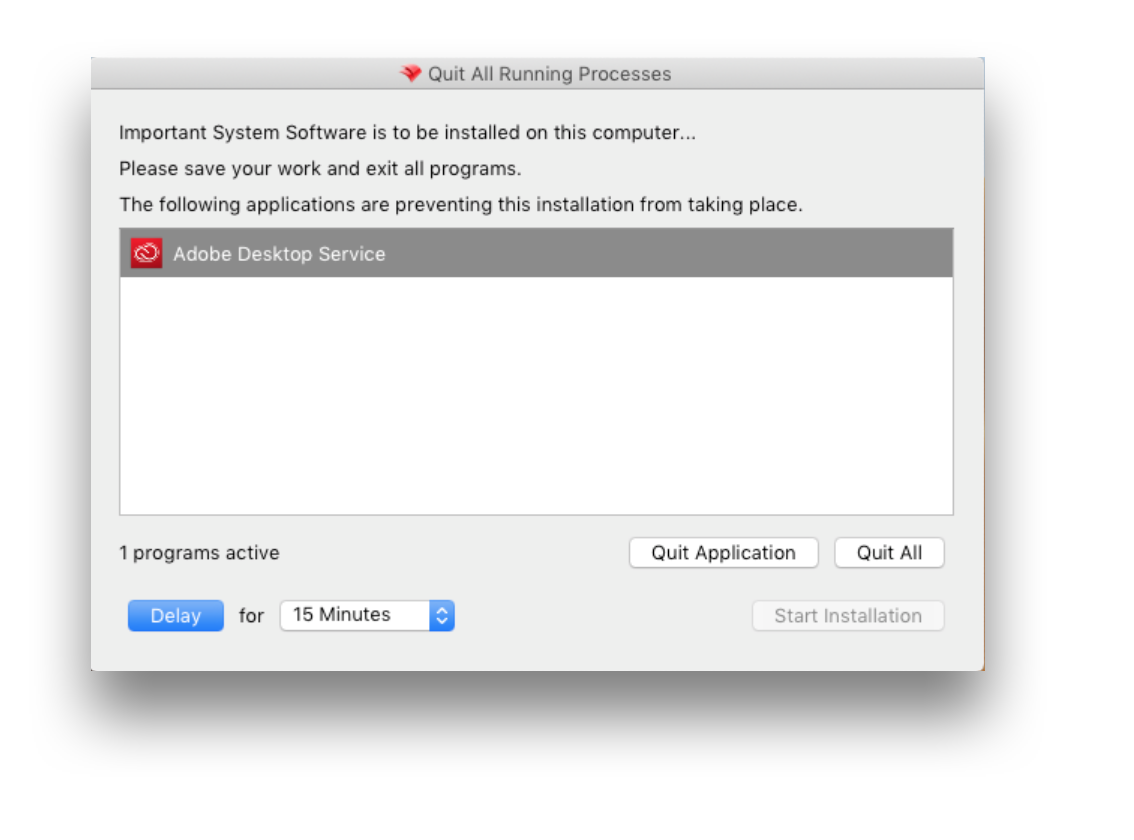
A background service can appear even when the user is not actively using the related application.
Solution
Requirements to prevent this experience are:
- Customized Kiosk Fileset
- macOS client: bundle ID of the app or service to exclude
- Windows client: process name to exclude
You can configure settings.ini to ignore specific apps or processes. Create a Fileset containing settings.ini, then associate it with the target clients. The destination folder depends on the operating system:
macOS
/usr/local/sbin/FileWave.app/Contents/Resources/fwGUI.app/Contents/customWindows (FileWave 15.5–16.4)
C:\Program Files\FileWave\kiosk\customThe desktop Kiosk reads these changes after the user logs out and logs in again.
To stop an unexpected process from blocking the reboot, first identify the listed app's bundle ID on macOS or process name on Windows.
Obtain Bundle ID or Process Name
Windows
- Send any Fileset with Fileset Properties set to Requires Reboot to the test machine.
- Hover over the desired process to exclude
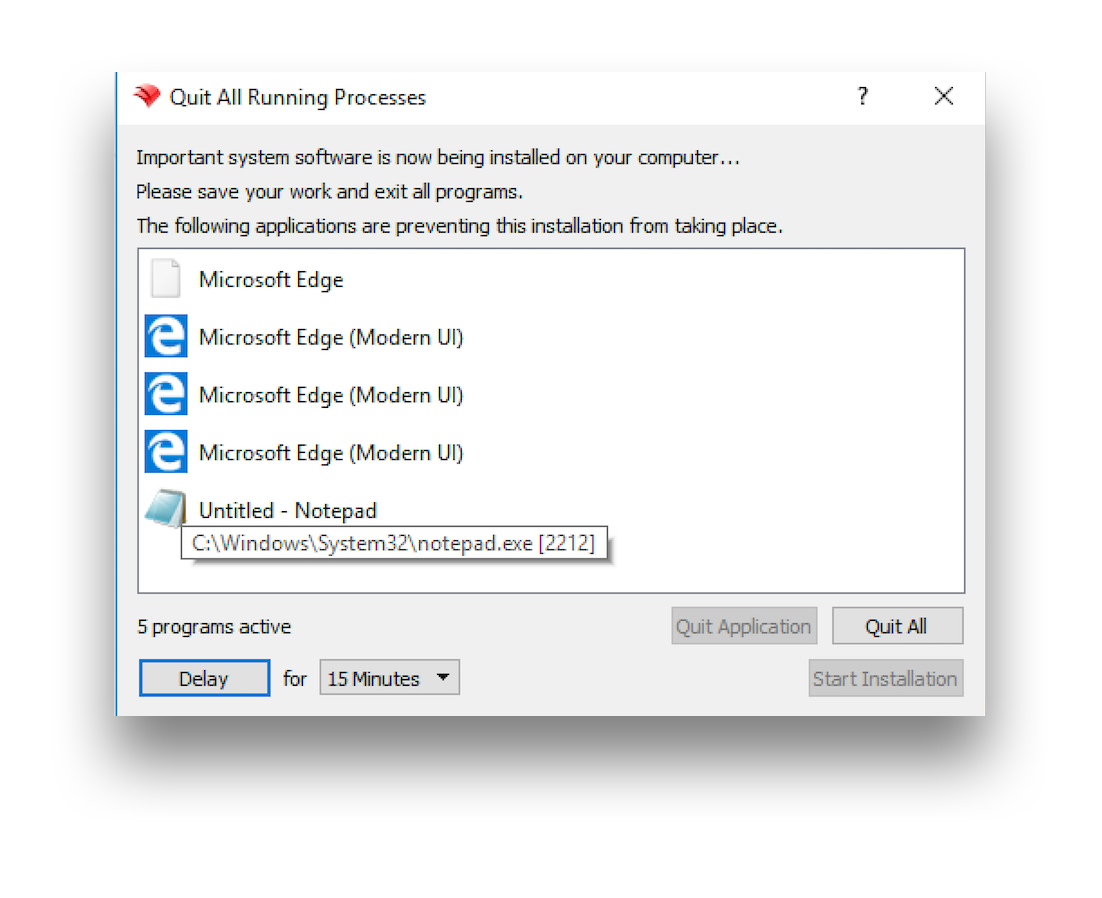
In this example, excluding Notepad requires notepad.exe.
macOS
- Change a test device's Debug Level to 99 through the Client Monitor
- Send any Fileset with Fileset Properties set to Requires Reboot to the test machine.
- When the device prompts the user to quit applications, open
FWGUI.login the user's Application Support directory.
~/Library/Application\ Support/FileWave/FWGUI.logThere should be lines similar to the following, for each process that has prevented the reboot:
|DEBUG|INSTALLER|[addProcessInfo] new process added /Applications/Utilities/Terminal.app pid 67345 bundleID com.apple.Terminal
|DEBUG|INSTALLER|[addProcessInfo] new process added /Applications/Preview.app pid 73400 bundleID com.apple.Preview
|DEBUG|INSTALLER|[addProcessInfo] new process added /Applications/TextEdit.app pid 73718 bundleID com.apple.TextEdit
Configure 'settings.ini'
Configure settings.ini with the following format. Use a comma-separated list for bundle IDs or process names:
[General]
ignoredApplications=com.bar, com.foo
For the example of Windows Notepad, it should read:
[General]
ignoredApplications=notepad.exe
For common Windows shell processes that can appear during reboot prompts, consider ignoring the following:
[General]
ignoredApplications=StartMenuExperienceHost.exe,SearchApp.exe,TextInputHost.exe
For the example of macOS TextEdit, it should read:
[General]
ignoredApplications=com.apple.TextEdit
For an earlier Client, a combined ignore list may look like this:
[General]
ignoredApplications=com.adobe.acc.AdobeDesktopService,com.apple.TextEdit
Deployment
Deploy settings.ini to the following locations:
macOS
/usr/local/sbin/FileWave.app/Contents/Resources/fwGUI.app/Contents/customWindows (FileWave 15.5–16.4)
C:\Program Files\FileWave\kiosk\custom
No comments to display
No comments to display