
License Management
Optional: understand software license counts
License Management tracks Apple Apps and Books licenses and administrator-defined application or font license records. Use it after your one-device Inventory Report. Begin by reading an existing record, not by adding a purchase order or changing an assignment. These software/content records are separate from the license that permits your organization to use FileWave itself. To check FileWave device-license usage and expiration, see Check FileWave License Counts and Expiration Dates.
First check: reconcile an existing test-app record
Before you begin, connect FileWave Central to the intended Server, confirm that you have permission to view License Management, and identify your test device and app. If your environment has no suitable license record, skip this optional lesson or ask the environment owner to provide a demonstration record. Do not invent purchase orders in production.
- Open License Management and select an existing record for the app used in your test. Check whether it comes from an Apple token or an administrator-defined license.
- Record the displayed owned, in-use/consumed, and available counts where shown. For Apple content, check the supplying token/location. For a manually defined license, review the purchase records and whether matching inventory or Fileset Status supplies the count.
- Double-click the record to inspect where licenses are consumed. Find your test device or the assigned user, as appropriate. If you cannot reconcile the record with your test, check scope and identity before making changes.
- Compare that evidence with the fresh inventory and device-side result from your deployment test. License allocation alone does not prove installation, launch, or active use. You are done when you can explain what this record counts and what it does not prove.
| Evidence | What it can tell you | What it does not establish |
|---|---|---|
| Apple owned/assigned/available counts | Licenses acquired and allocated through the relevant token/location | That the app installed or is being used |
| Inventory criteria | Reported application or font records that match your definition | Complete fleet coverage, active usage, or legal rights to use the software |
| Fileset Status tracking | Deployment information for a selected FileWave Fileset | Every copy installed outside FileWave or independent application health |
| Vendor agreement and purchase evidence | Entitlements under the vendor's terms | That FileWave's matching criteria and inventory are accurate |
A FileWave compliance label compares the records and counts configured in FileWave. It is not independent legal proof of entitlement. Per-user, per-device, subscription, and other licensing terms can differ; have the license owner reconcile the report against the applicable agreement.
If counts do not match: check token/location, device or user assignment, report criteria, purchase records, permissions, and inventory freshness. Do not change a license count to make a warning disappear. Do not revoke a user's license, retire a VPP user, or run Update Model merely to refresh a read-only check.
Apple Apps and Books (VPP) tracking
Apple manages this content through Apps and Books in Apple School Manager or Apple Business Manager; FileWave retains VPP in token and license labels. The view shows owned licenses, licenses in use, compliance, and the supplying token. Purchase synchronization, license assignment, application installation, and device inventory are separate processes. Check the actual synchronization status with your administrator rather than treating a fixed wait as proof of completion.
Viewing where licenses are consumed
The detail view identifies the device serial number for Device Assignment or the VPP User account for User Assignment. Managed Distribution application licenses can be revoked and redistributed through the appropriate managed workflow; books and redeemed codes have different ownership rules. Do not test revocation on an active user. A Kiosk offer or a Deployment is not, by itself, proof of the exact license-consumption state: inspect the assignment details and the actual deployment result.
- Open FileWave Central and navigate to "License Management".
- Double-click a VPP License.
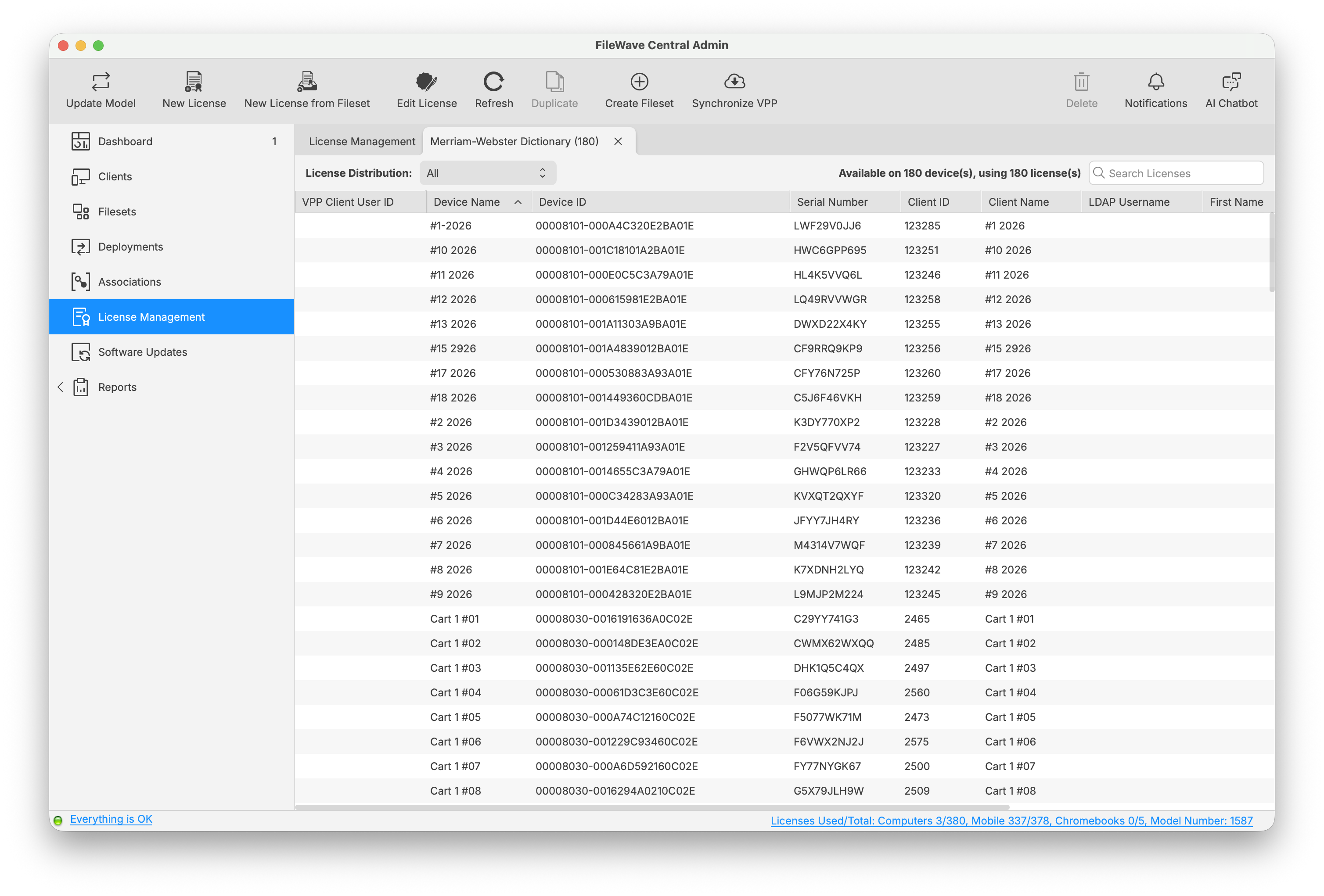
For current shortage behavior, see Identify VPP license shortages in FileWave 16.4. FileWave checks shortages during Model Updates and Smart Group evaluations; a device without an available license is not reported as successfully associated for that VPP app. The broader reference also contains historical VPP setup and redeemable-code workflows; those are not the first-test setup route.
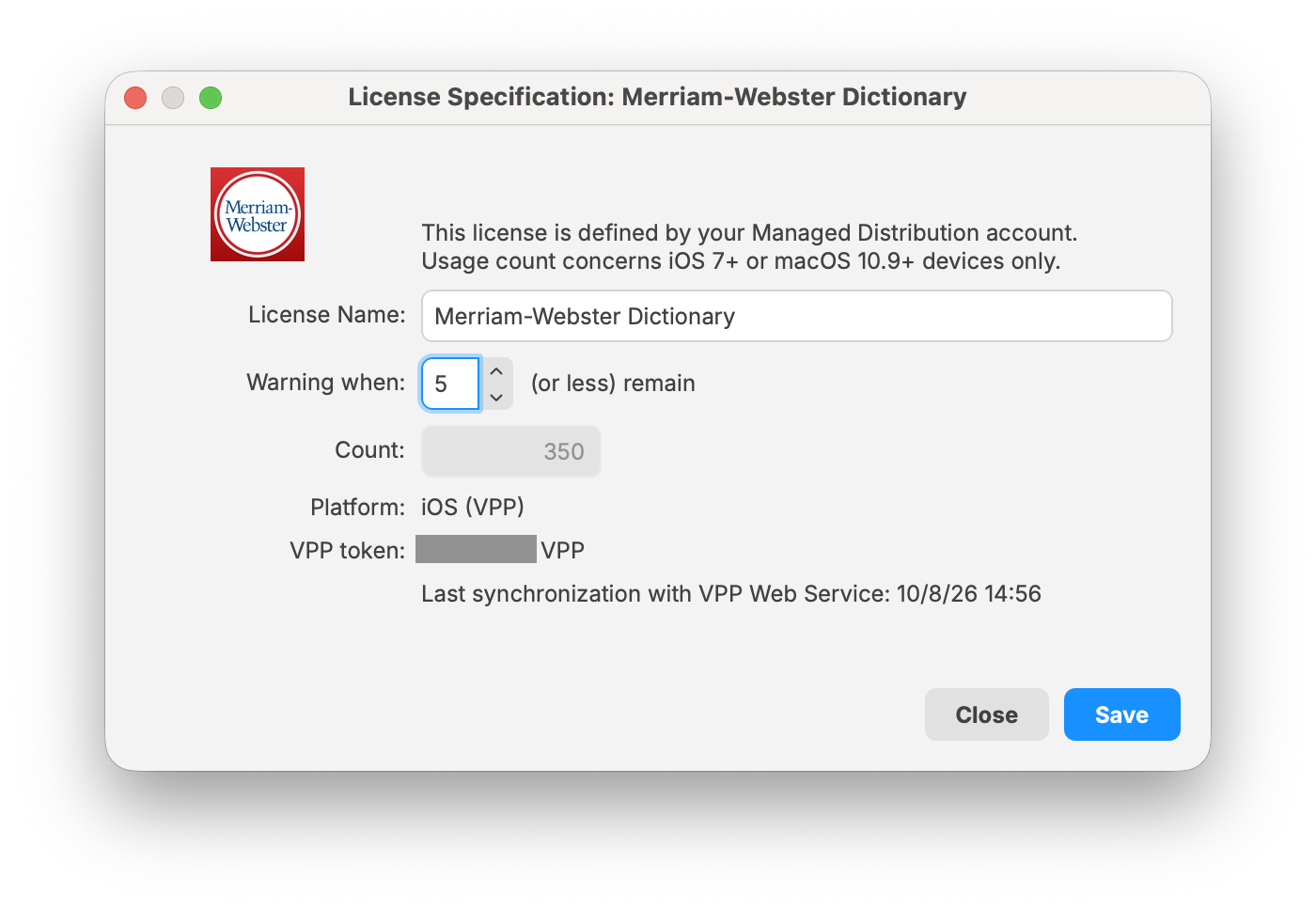
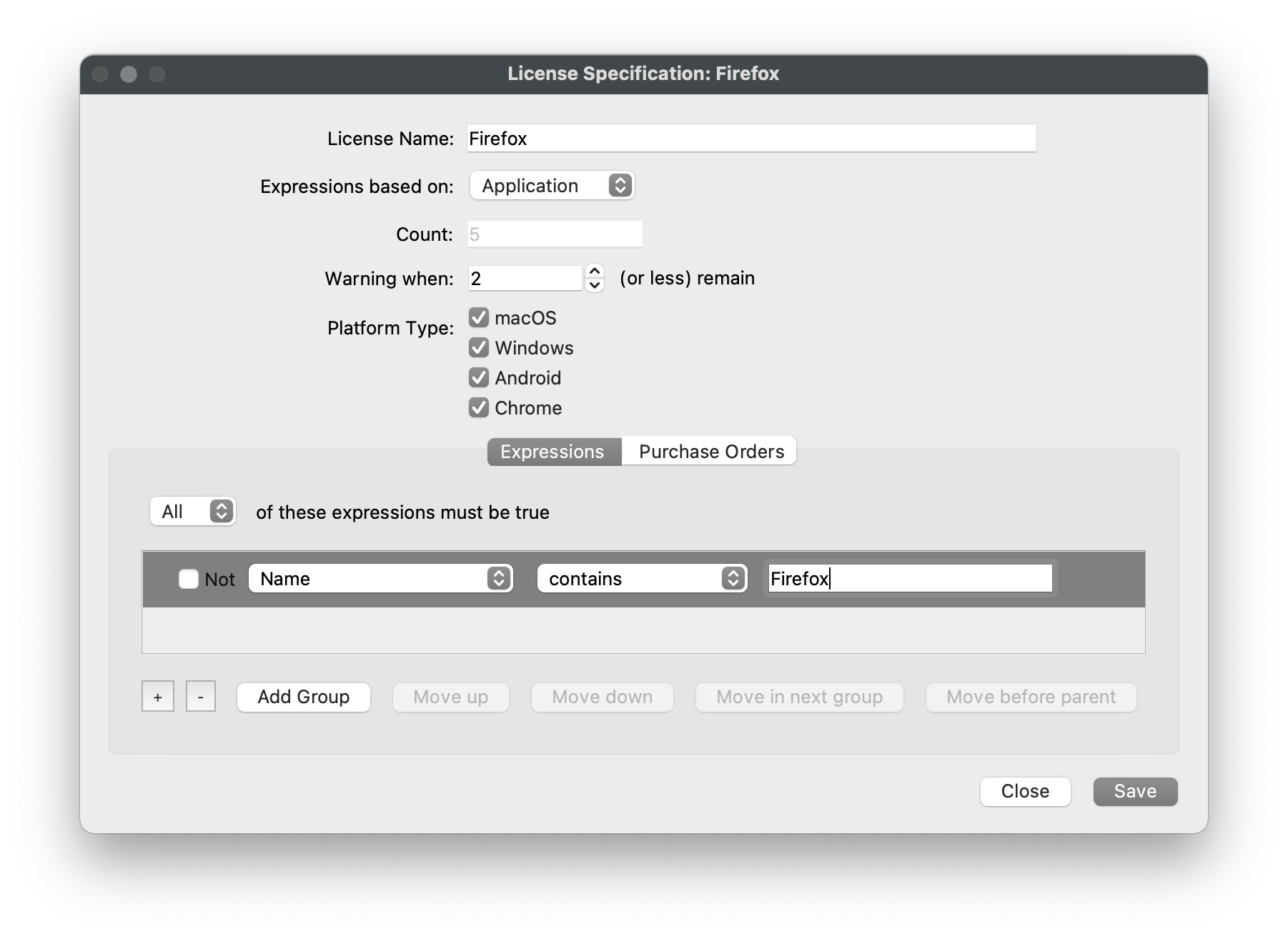
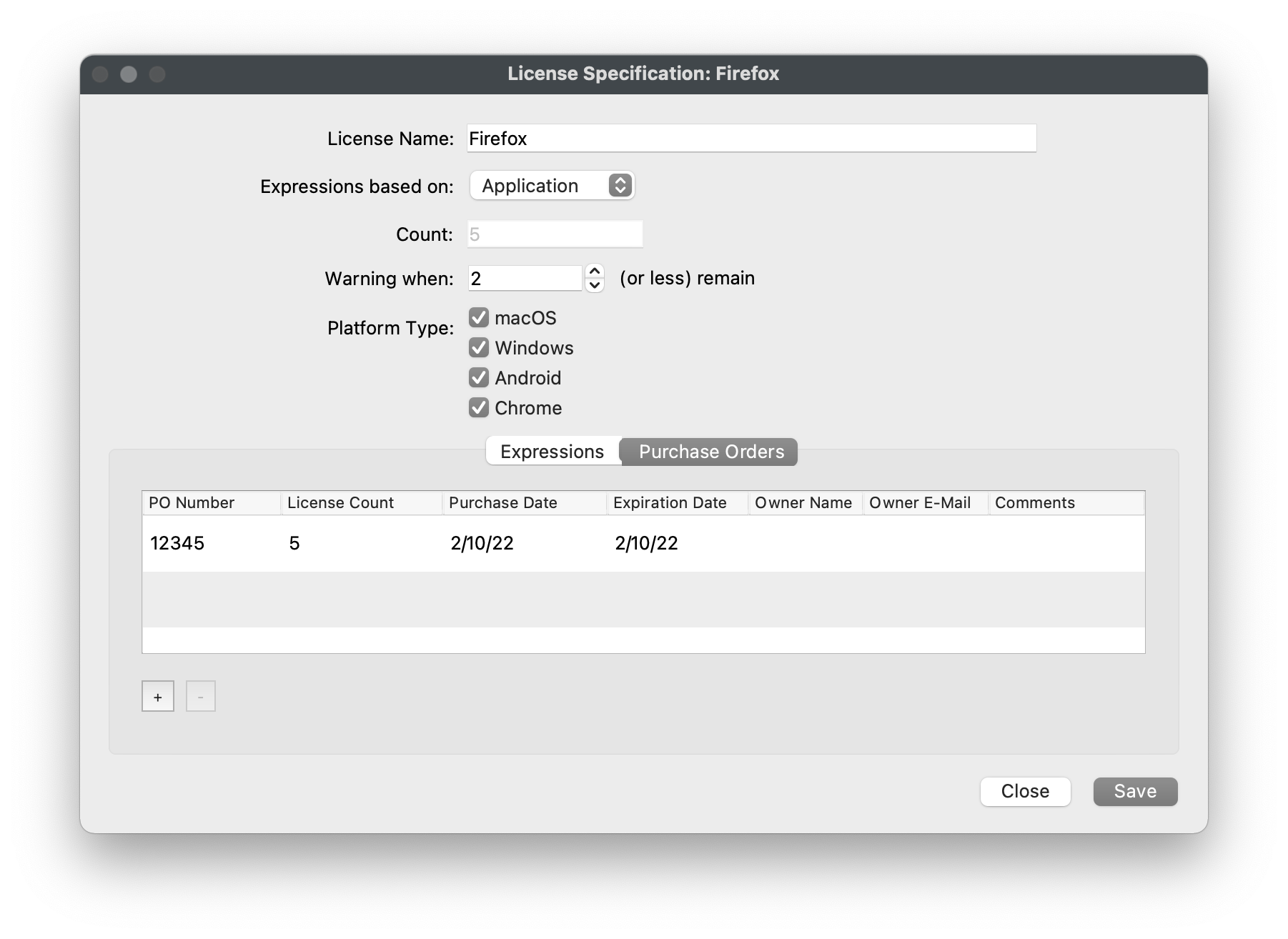
The images here are older interface examples. Their applications, counts, purchase-order values, and user/device lists are examples, not values to copy into your environment.
Optional: set a warning threshold
With the license owner's approval, adjust the threshold on the chosen record and note the previous value so you can restore it. The threshold controls the displayed warning; it does not by itself configure email delivery. For an approved email test, use Scheduled Reports with configured Mail preferences, an authorized recipient, and a schedule you will remove afterward.
- Open FileWave Central and navigate to "License Management".
- Select a VPP License.
- Click "Edit License" from the toolbar.
- Change the "Warning when:" field to set your License Warning threshold.
- Click "Save".
- If the available license count falls below your threshold, FileWave shows the License Compliance status "Warning License Watermark".
Optional: define non-VPP license tracking
For content outside Apple Apps and Books, choose inventory criteria to detect matching applications/fonts or use an existing Fileset to track FileWave deployment status. Check what the selected platform and management method actually report; a platform selection is not a guarantee of complete inventory. Scheduled Reports can email this license information, subject to the report owner's permissions.
Creating a new License definition
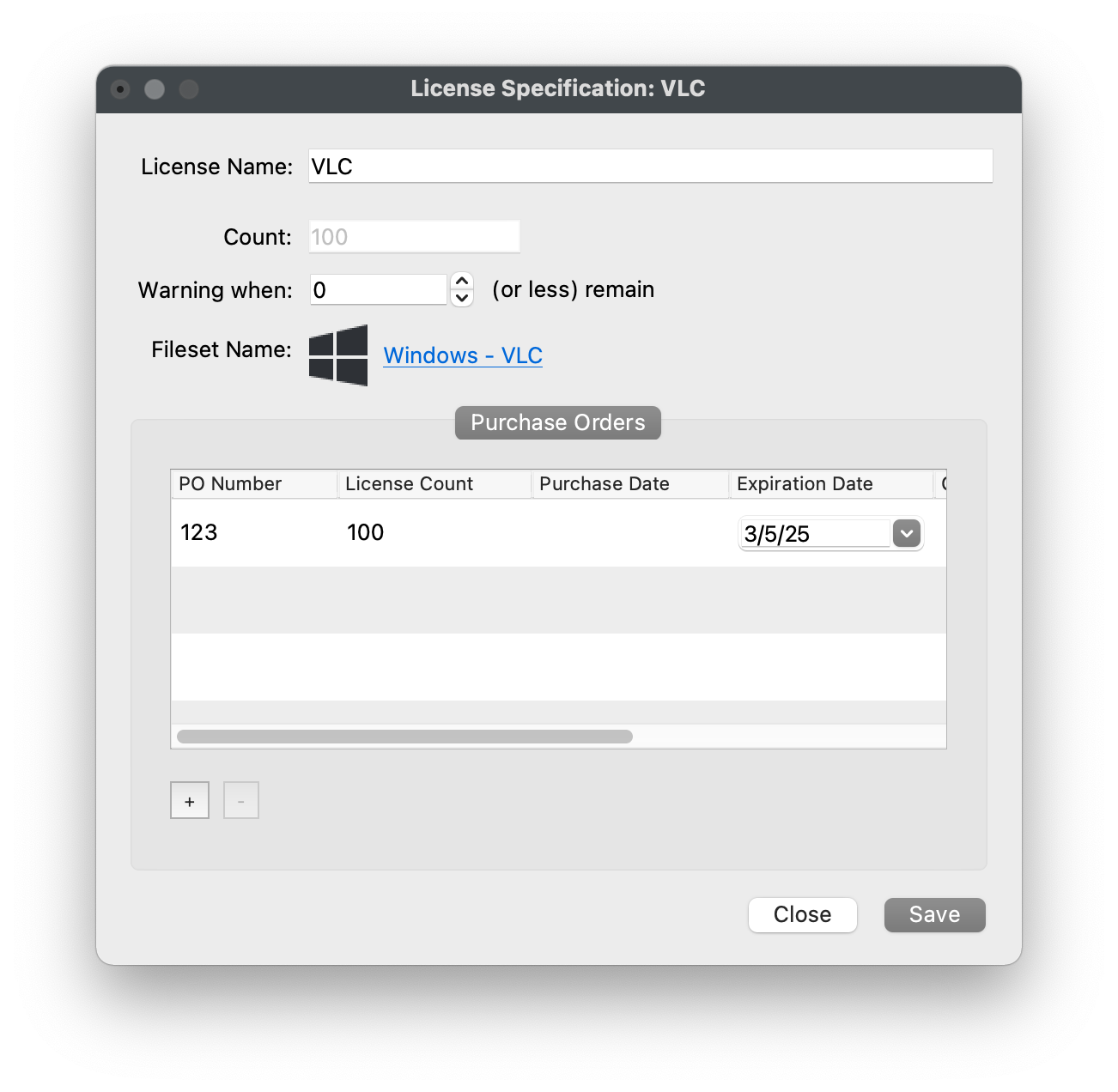
Use inventory-based definitions for matching reported applications or fonts, including those installed outside FileWave. Do this only if the read-only review is complete and you have approval to create a separate Evaluation — test application record in the approved test environment. Back up existing records first. Use approved demonstration purchase data clearly marked as such, or actual purchase evidence supplied by the license owner; never invent a production entitlement. The Firefox images demonstrate the interface, not a claim that Firefox requires a paid per-device license.
- Open FileWave Central and navigate to "License Management".
- Click "New License" from the toolbar.
- Name the License, select Application or Font, choose the Warning threshold, and select the platforms you want to track.
- Click the "[+]" to add criteria for the selected Application or Font type.
- Enter the "Qualifier" (for example, Firefox).
- Click the "Purchase Orders" button.
- Click the "[+]" to add a new Purchase Order entry.
- Enter the approved PO Number and License Count. These fields record purchase evidence; entering a number does not acquire a license or establish legal rights.
- Optionally, fill out the rest of the Purchase Order fields.
- Click "Save".
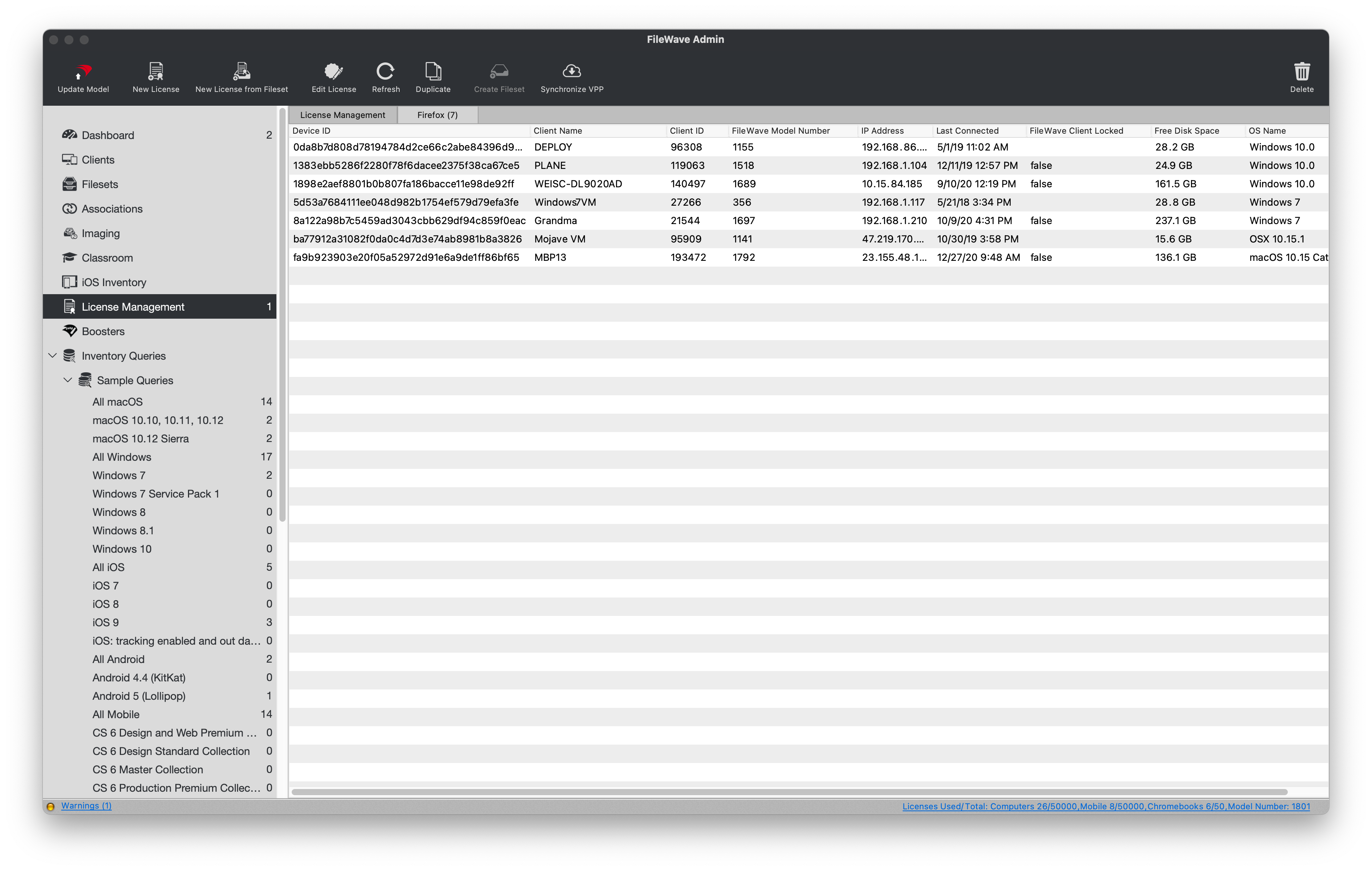
- Open the new definition and inspect which device/application records it counts. Confirm the criteria or Fileset and the purchase entries before relying on the result.
Track Fileset Usage
This method uses Fileset Status to track deployments made through FileWave. It does not measure application usage, and you should not assume it counts installations performed outside that Fileset. Use a separate evaluation-only record and approved purchase data, as described above.
- Open FileWave Central and navigate to "License Management".
- Click "New License from Fileset" from the toolbar.
- Name the License, choose the Warning threshold, and select the Fileset you want to track.
- Click the "[+]" to add a new Purchase Order entry.
- Enter the approved PO Number and License Count. These fields record purchase evidence; entering a number does not acquire a license or establish legal rights.
- Optionally, fill out the rest of the Purchase Order fields.
- Click "Save".
- Open the new definition and inspect which device/application records it counts. Confirm the criteria or Fileset and the purchase entries before relying on the result.
Viewing where licenses are consumed
- Open FileWave Central and navigate to "License Management".
- Double-click a License.
Finish the optional test
Reconcile the counted device or application records with your intended scope and current evidence. Restore any warning threshold changed for the demonstration. If you sent a scheduled report, confirm receipt and its contents before removing the test schedule. Before removing an evaluation-only license definition or schedule, check that you created it and that no shared reporting depends on it. After removal, verify that it is absent from the relevant list. Do not alter production purchase records or revoke application licenses as routine cleanup.
No comments to display
No comments to display