
Fileset Association types and precedence
A Fileset can reach a device through a Deployment or a legacy Association, and a device can sometimes receive the same Fileset through more than one target path. This article explains how direct targets, clones, and nested groups affect which assignment takes precedence.
The precedence rules apply to both workflows. Deployments are the current assignment workflow, while the screenshots below show the legacy Associations interface. Each FileWave Client receives one manifest, so the same target-distance rules apply regardless of how the Fileset-to-client link was created.
1:1 Associations
A direct assignment links a Fileset to a device or device clone rather than to a group.
Standard Association
Automatically installed without user intervention
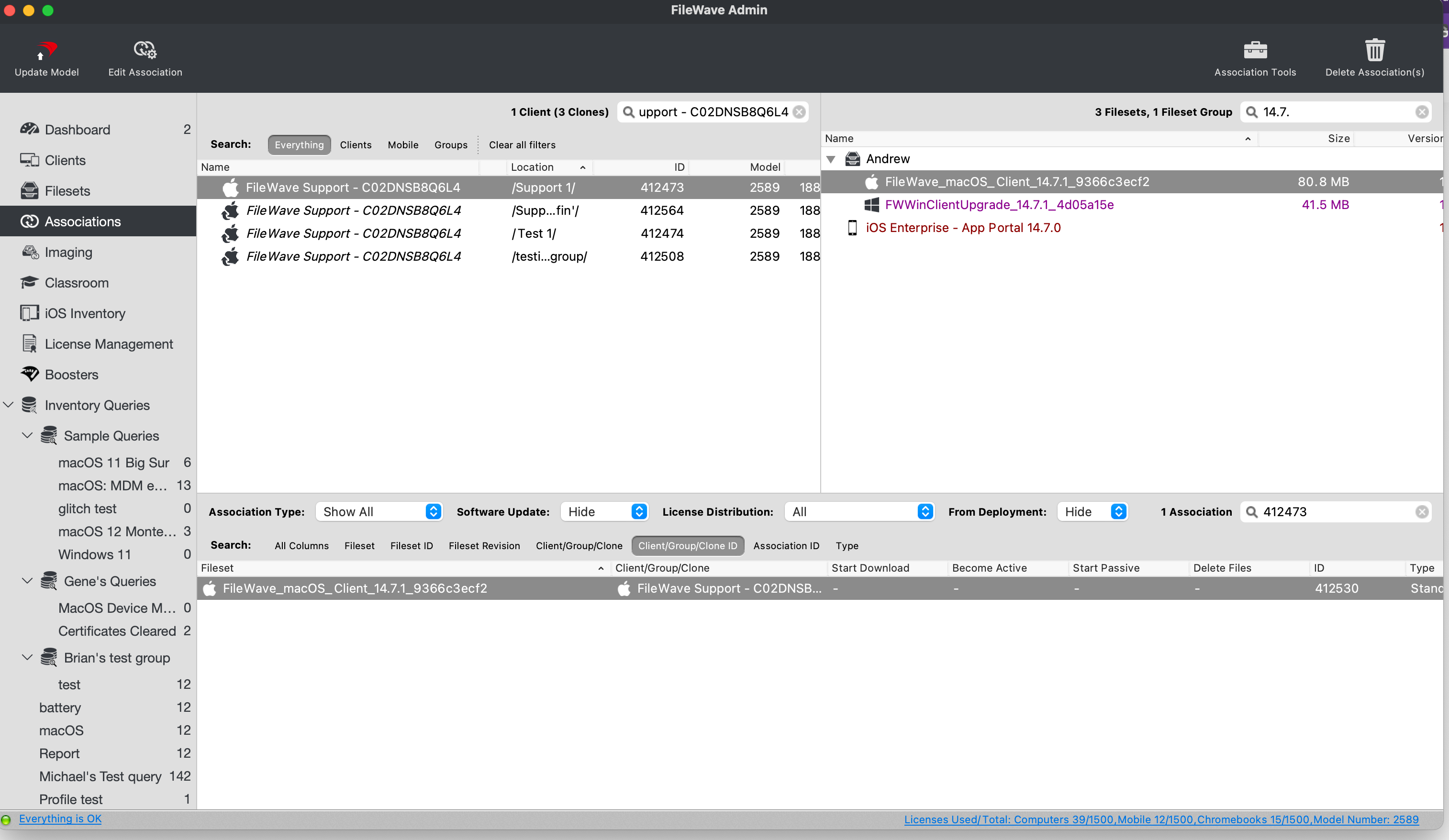
In the above image, one Fileset is associated directly with this device; Type – Standard
Kiosk Associations
User initiated installation from the Kiosk Menu Item or System Tray.
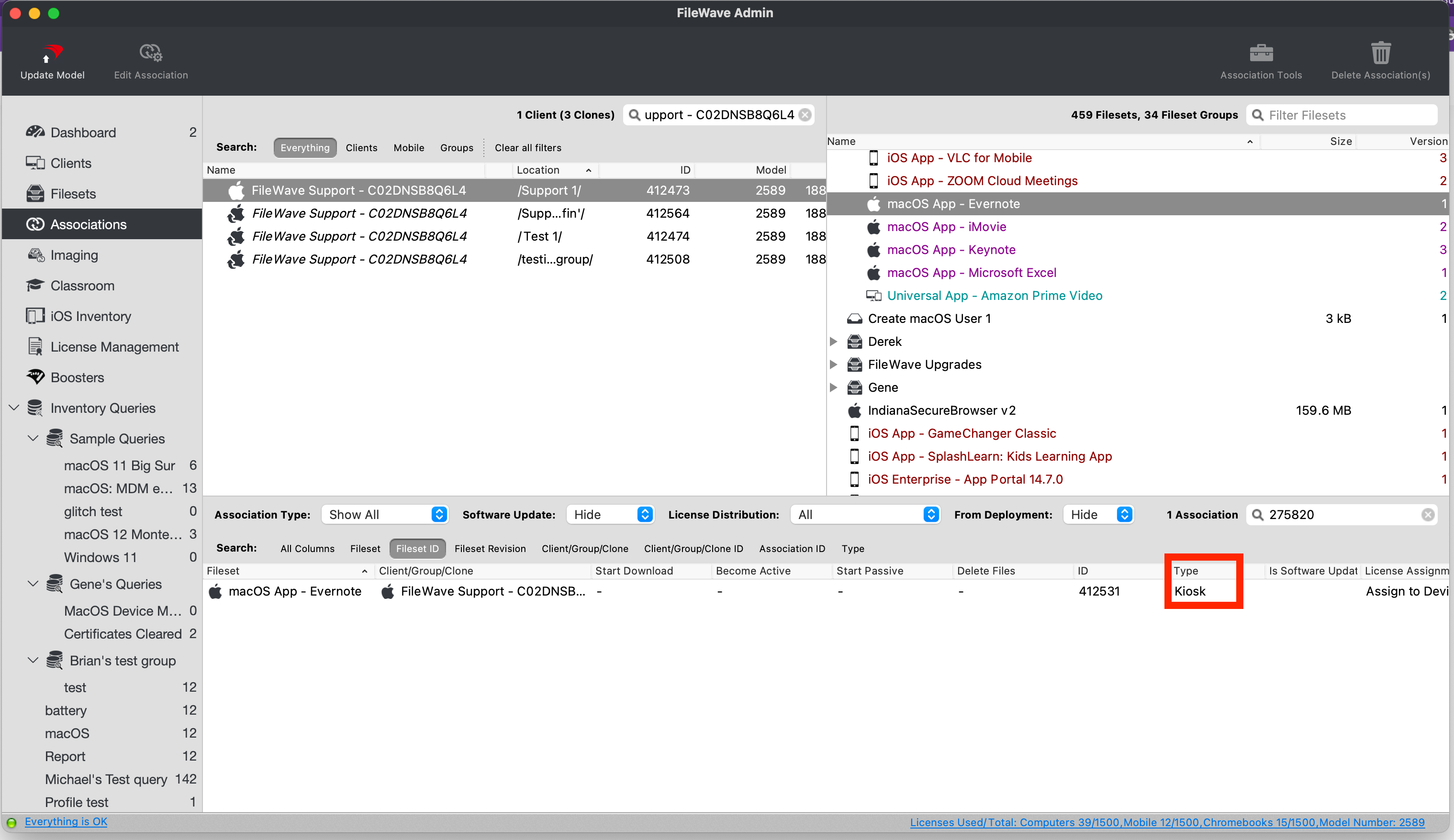
In the above image, one Fileset is associated directly with this device; Type – Kiosk
Group Based Associations
A group-based assignment links a Fileset to a static or Smart Group and reaches the devices within that group.
The below image shows the same Fileset associated with two different client groups; one group nested inside another group.
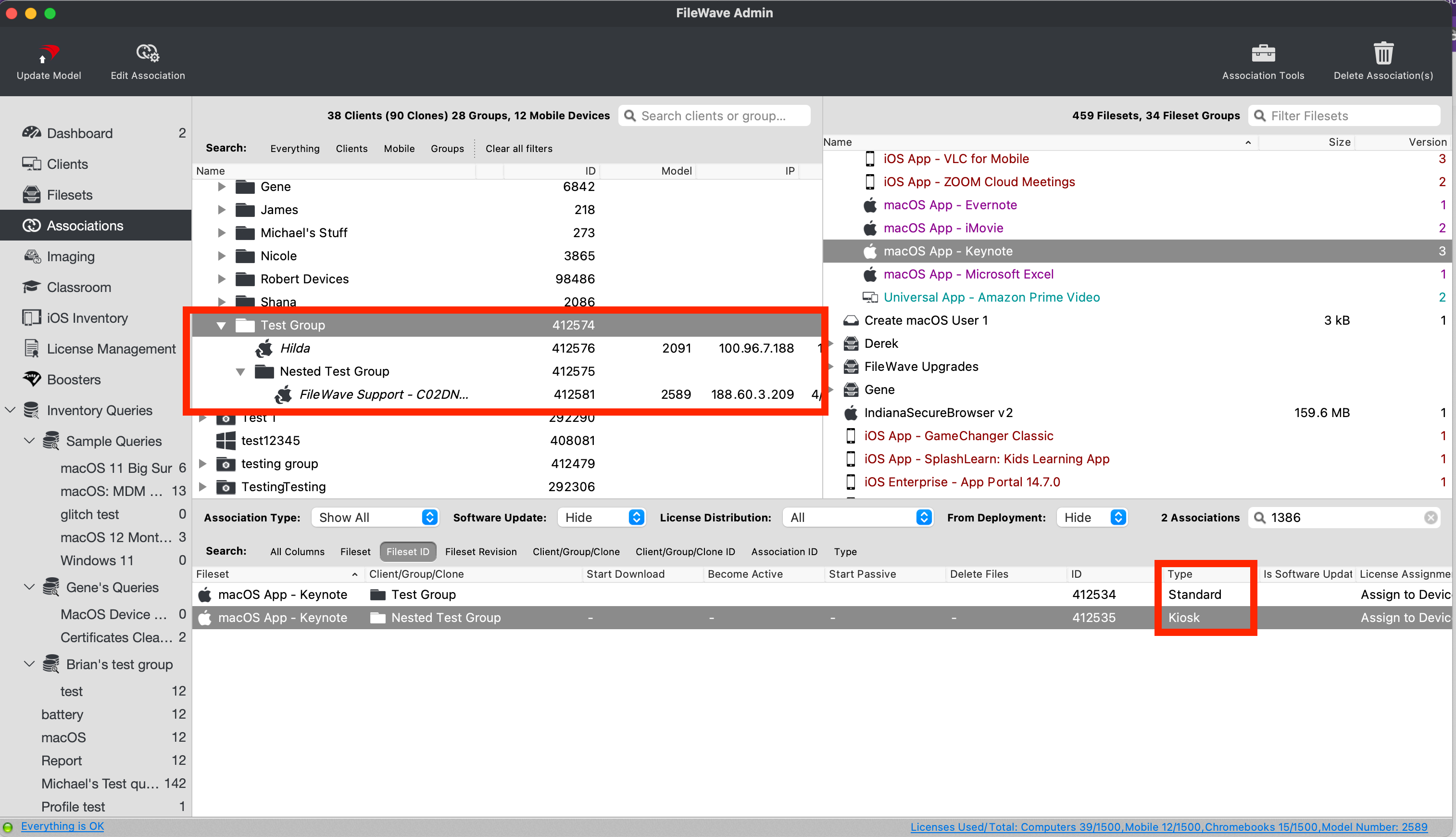
This example demonstrates the Keynote Fileset associated with two Client Groups: Test Group and Nested Test Group.
Expected behavior:
- Client 'Hilda' will install Keynote without user intervention
- Client 'FileWave Support - C02DNSB8Q6L4' will have Keynote available to the user via the Kiosk.
The below image provides another more complex example, with more nested groups.
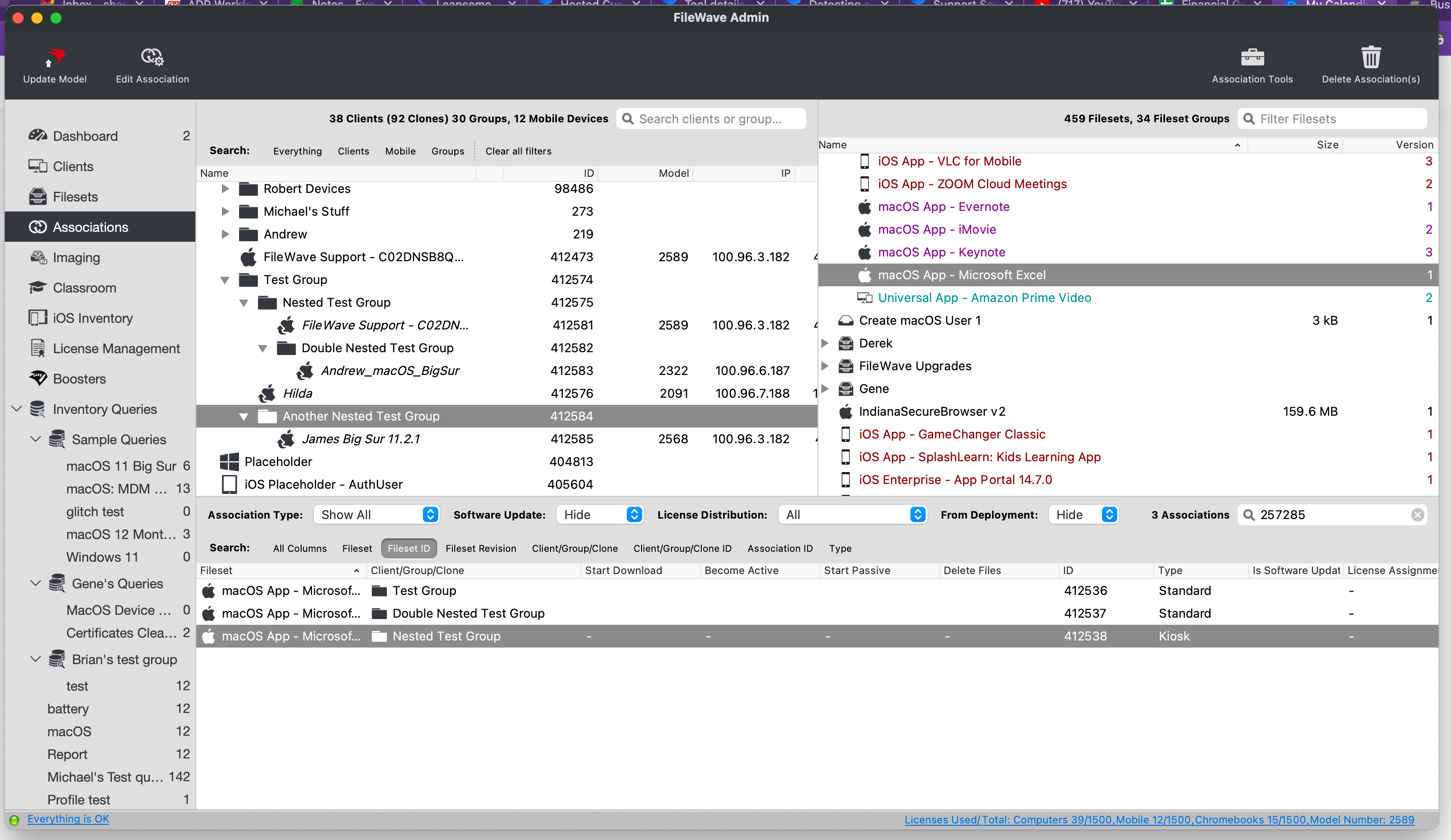
Excel Fileset is associated with three groups: Test Group, Nested Test Group, and Double Nested Test Group.
Expected behavior:
- Client 'FileWave Support - C02DNSB8Q6L4' will have Excel available via Kiosk.
- Client 'James Big Sur 11.2.1', 'Andrew_macOS_BigSur' and 'Hilda' will install Excel without user intervention.
Association Distance
Where the same Fileset is associated to a device by more than one path, the device's 'closest' association should win.
- Direct Association to devices is closer than a Direct Association to a Clone
- An assignment to a parent group is closer than an assignment to one of its nested groups
- Association to a group is closer than a Clone within that group.
Each association is given a score.
|
Association to... |
Score |
|
Device |
0 |
|
Device Clone |
1 |
|
Static/Smart Group |
2 |
|
Clone of Static/Smart Group |
2 |
The score is determined starting with the device or clone and working back to the actual association.
Example
Consider the below Tree Structure:
Root

+ Static Group 1 -     2__
                                             |
      + Static Group 2 -     2__
                                                   |
            + Static Group 3 -     2__
                                                         |
                + Smart Group 1 -      2__
                                                               |
                        + clone of device   -  1

+ Static Group 4 - 2__
                                         |
      + Smart Group 2 -  2__
                                                |
            + clone of device - 1
Total Scores (lowest score wins):
|
Association to... |
Scoring |
Total |
|
Static Group 1 |
1 + 2 + 2 + 2 + 2 |
9 |
|
Static Group 3 |
1 + 2 + 2 |
5 |
|
Smart Group 1 |
1 + 2 |
3 |
|
Clone of device in Smart Group 1 |
1 |
1 |
|
Static Group 4 |
1 + 2 + 2 |
5 |
|
Smart Group 2 |
1 + 2 |
3 |
In this example, the assignment through Smart Group 1 is closer to the device than the assignment through Static Group 4.
Matching Score
The closest target path wins. If two legacy Associations have the same distance score, the Association with the highest ID wins, which is normally the one created most recently.
Hence, if an association of a Fileset was made to Smart Group 2 and then to Smart Group 1, the association to Smart Group 1 would win, as this equidistant association is the latest and hence will have the highest Association ID.
No comments to display
No comments to display