
Custom MSI installer parameters
What
FileWave can add custom parameters to MSI Filesets. This applies to Filesets created from MSI files, but not to Filesets that FileWave creates automatically from Windows software updates.
When/Why
Some MSI installers accept custom parameters that will change the way software is installed. For example, many MSI installers allow the software installation path to be defined via an additional option at runtime. Two such examples are:
| Application | Instal Path |
| UltraEdit | TARGETDIR="<my-desired.path>" |
| 7Zip |
INSTALLDIR="<my-desired.path>" |
You usually do not need to add a silent-install option here. FileWave already runs MSI installs silently.
How
Start with a Fileset created from the vendor’s MSI installer. If you have not created it yet, follow the MSI creation steps in Create and Update PKG and MSI Filesets. Then use either FileWave Central or FileWave Anywhere below. Check the vendor’s documentation for the properties accepted by that exact installer; the examples above are not interchangeable between packages.
FileWave Central
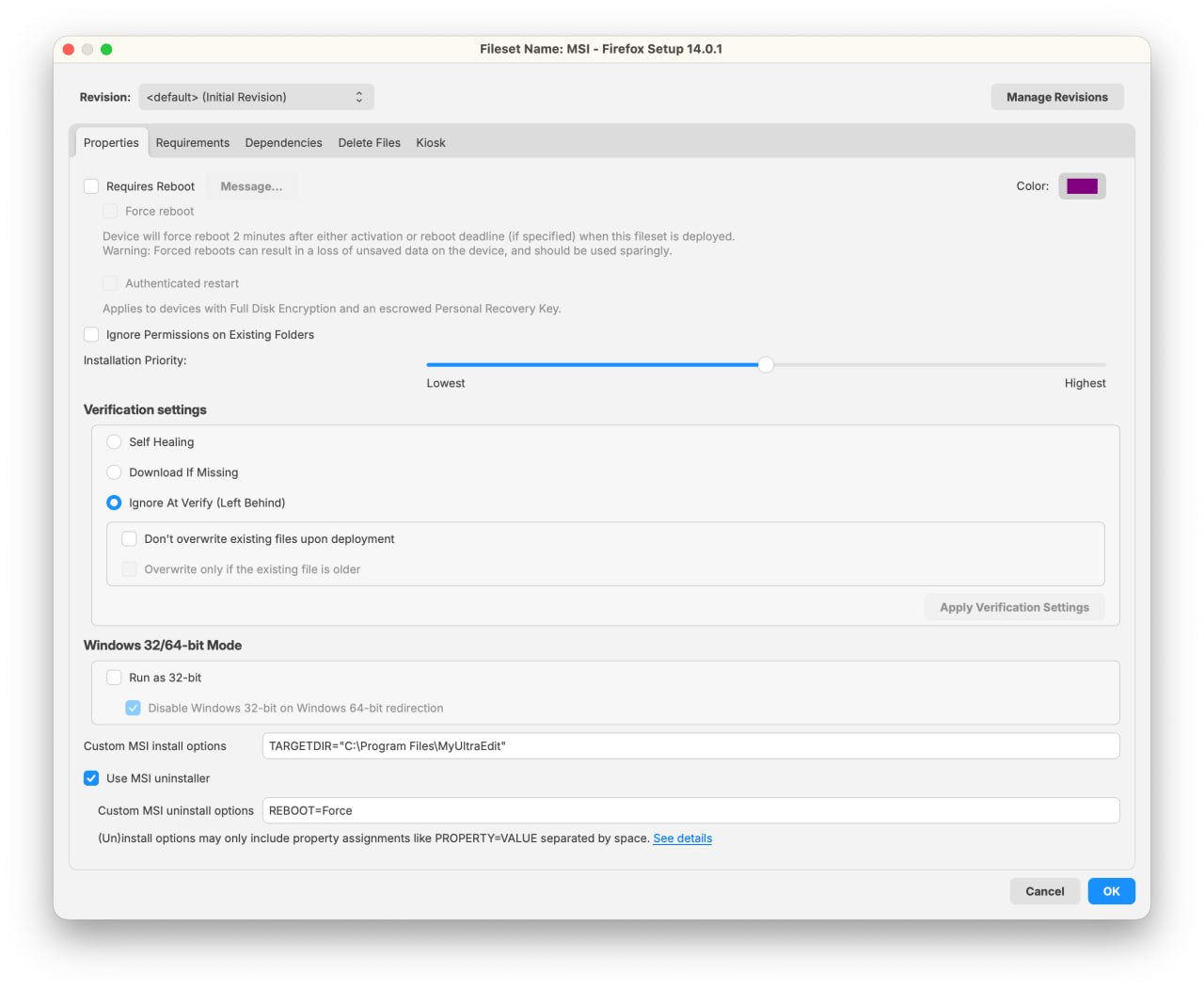
In Filesets, open the MSI Fileset and select Properties. Enter the required options in the appropriate field:
- "Custom MSI install options"
- "Custom MSI uninstall options"
FileWave Anywhere
In Filesets, open the MSI Fileset and select Fileset Settings. Older Anywhere versions label these areas Payloads and Payload Settings. Enter the required options in the appropriate field:
- "Custom MSI install options"
- "Custom MSI uninstall options"
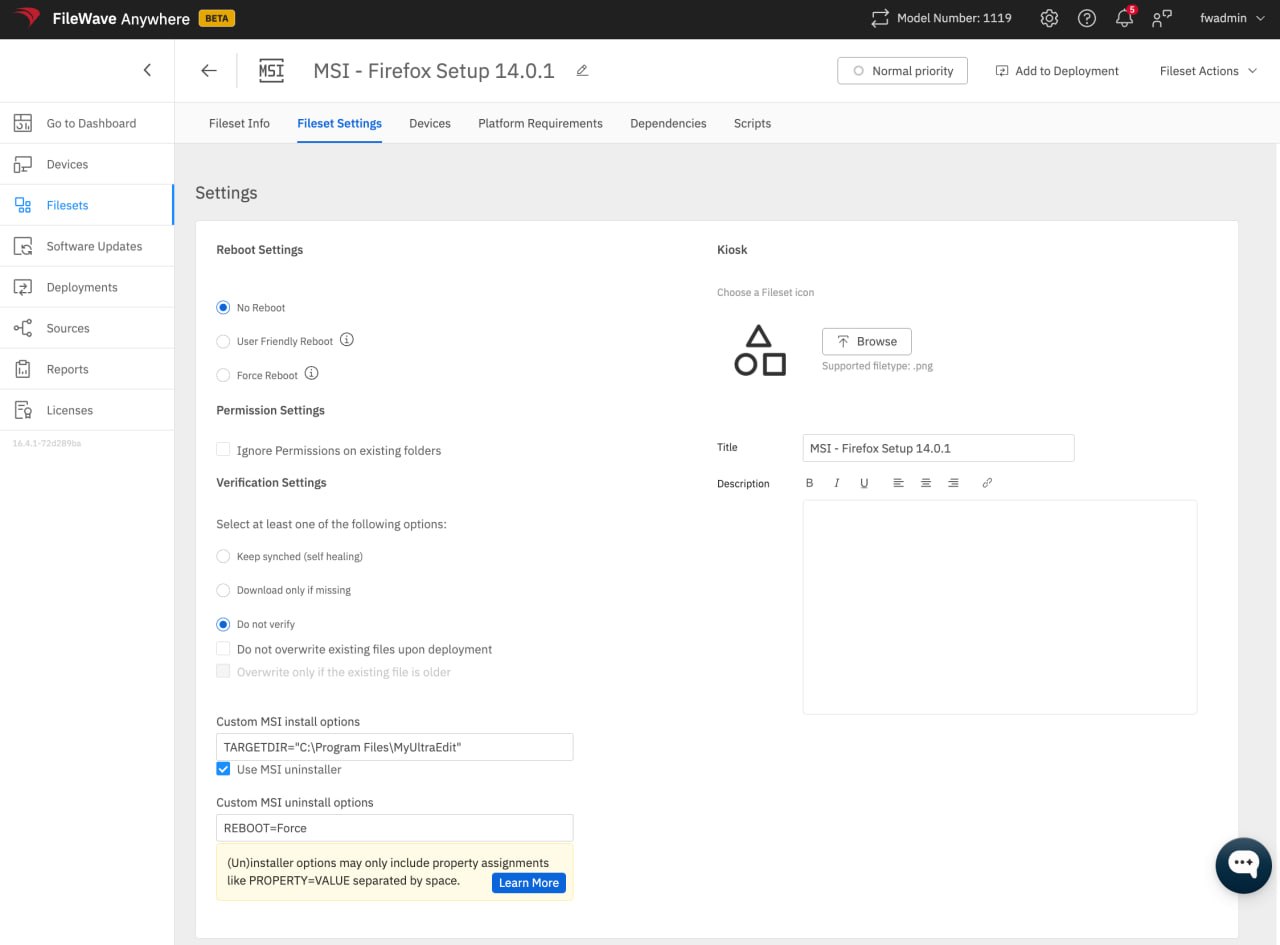
These Central and Anywhere screenshots show where to enter options, not a recommended Firefox configuration. Although the example Fileset is named Firefox, the TARGETDIR value shown is the UltraEdit installation-path example above. Use only properties supported by your installer. The uninstall field shows REBOOT=Force; do not copy this forced-reboot example unless that behavior is intended and has been tested on a pilot device.
Multiple Options
Multiple options may be specified at the same time and should be separated by spaces. Keep a value that contains spaces inside double quotation marks, as in the installation-path examples above.
For example, to install TeamViewer Host with multiple properties, use a format like this: SETTINGSFILE="YOURPATH\yourfilename.tvopt" APITOKEN=xxxxxx CUSTOMCONFIGID=xxxxxx
Parameters
Parameters may be used to define options, including Custom Fields.
Example
For TeamViewer Host, you may want to keep the APITOKEN out of the visible MSI options while still passing it to the installer at runtime. A Custom Field can store that value.
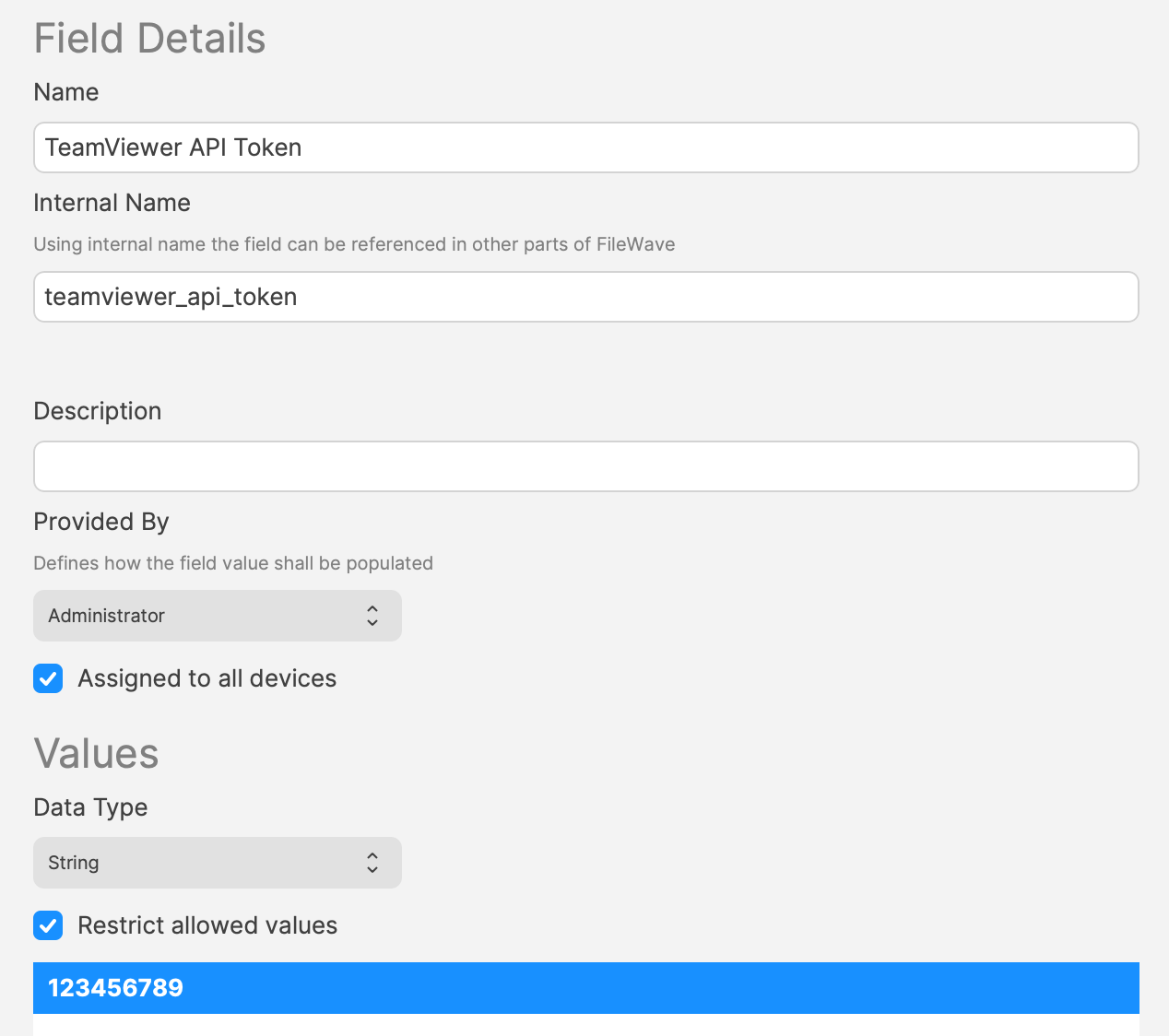
The Custom MSI install options could then be:
APITOKEN=%teamviewer_api_token%
Parameters can include MSI properties such as SETTINGSFILE, APITOKEN, or CUSTOMCONFIGID.
Custom MSI settings can define options that start with a leading / or special parameters such as ALLUSERS. When you use Custom Fields as parameters, FileWave removes options with a leading / and special parameters such as ALLUSERS so hidden parameter values cannot silently force behavior such as a reboot.
The See details link in FileWave Central and Learn More button in FileWave Anywhere direct to this page.
Information
Option definitions:
| Custom MSI install options | Options passed to the MSI during Fileset activation. |
| Custom MSI uninstall options |
Options passed to the MSI when the Fileset is disassociated. Requires 'Use MSI Uninstaller' to be enabled and that the MSI uninstaller supports this option. (Firefox is an example of an MSI that does not support this feature) |
Save and test the options
Save the Fileset settings (OK in the Central dialog), assign it to a representative Windows pilot using a Deployment, and run Update Model after reviewing the shared pending changes. After activation, check both the Fileset status and the actual result on the device, such as the installed path. If you configured uninstall options, test removal on the pilot as well; a successful installation does not prove that the package accepts the same options during removal.
Related Content
- 7zip (Windows MSI) - Using a custom parameter to install 7zip on Windows
No comments to display
No comments to display