
Windows Requirement Script Examples
Requirement scripts run on client devices at each tickle interval, 2 minutes by default, to check whether installation conditions are met. A script can check for a file, registry key, service, or process before allowing Fileset activation. Common uses include:
- Block redundant installations if the app is already present or
- Ensure prerequisites are present or
- Enforce a particular installation order.
If a requirement script returns any exit code other than 0, such as 1 or -1, FileWave treats it as a failure and reports Requirements Failure: Script in the Client Info window and Fileset Report. The Fileset contents will not download or install until all requirement scripts return 0. To check multiple conditions, add multiple requirement scripts.
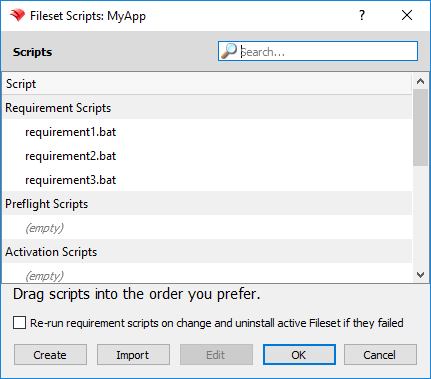
The examples below are Windows requirement scripts you can adapt. If you need the opposite condition, swap the exit codes in the example.
Install if registry key present
::Replace HKLM\path\to\registry\key with the actual path to the registry key, e.g. HKLM\SOFTWARE\Macromedia\FlashPlayer

reg query "HKLM\path\to\registry\key"
if %ERRORLEVEL% EQU 0 (
    exit 0
) else (
    exit 1
)
Install if registry value present
::Replace HKLM\path\to\registry\key with the actual path to the registry key containing your value, e.g. HKLM\SOFTWARE\Macromedia\FlashPlayer
::Replace <value> with the actual name of the value, e.g. CurrentVersion in this example

reg query "HKLM\path\to\registry\key" /v <value>
if %ERRORLEVEL% EQU 0 (
    exit 0
) else (
    exit 1
)
Install if file or folder present
::Replace <drive>:\path\to\file\or\folder with the actual path to the file or folder, e.g. %ProgramFiles(x86)%\Mozilla Firefox\firefox.exe

if exist "<drive>:\path\to\file\or\folder" (
    exit 0
) else (
    exit 1
)
Install if application present in Programs & Features
::Replace <AppName> with the name of your app, e.g. Adobe Acrobat Reader DC
::Be as specific as possible because partial app names may provide a match when you don't necessarily want it to, e.g. Adobe will match both Adobe Acrobat Reader DC and Adobe Flash

reg export HKLM\Software\Microsoft\Windows\CurrentVersion\Uninstall %temp%\applist1.txt
reg export HKLM\Software\Wow6432Node\Microsoft\Windows\CurrentVersion\Uninstall %temp%\applist2.txt
copy %temp%\applist1.txt + %temp%\applist2.txt %temp%\applisttemp.txt
find "DisplayName" %temp%\applisttemp.txt > %temp%\applist.txt

find "<AppName>" %temp%\applist.txt
if %ERRORLEVEL% EQU 0 (
    del %temp%\applist*
    exit 0
) else (
    del %temp%\applist*
    exit 1
)
Install if service present
::Replace <service> with the name of your service from the Services control panel, e.g. Adobe Acrobat Update Service
::Be as specific as possible because partial service names may provide a match when you don't necessarily want it to, e.g. FileWave will match both FileWave Client and FileWave UltraVNC Server

sc query | find "DISPLAY_NAME" | find "<service>"
if %ERRORLEVEL% EQU 0 (
    exit 0
) else (
    exit 1
)
Install if process present
::Replace <process> with the name of your process, e.g. notepad.exe

tasklist /FI "IMAGENAME eq <process>" 2>NUL | find /I /N "<process>"
if %ERRORLEVEL% EQU 0 (
    exit 0
) else (
    exit 1
)
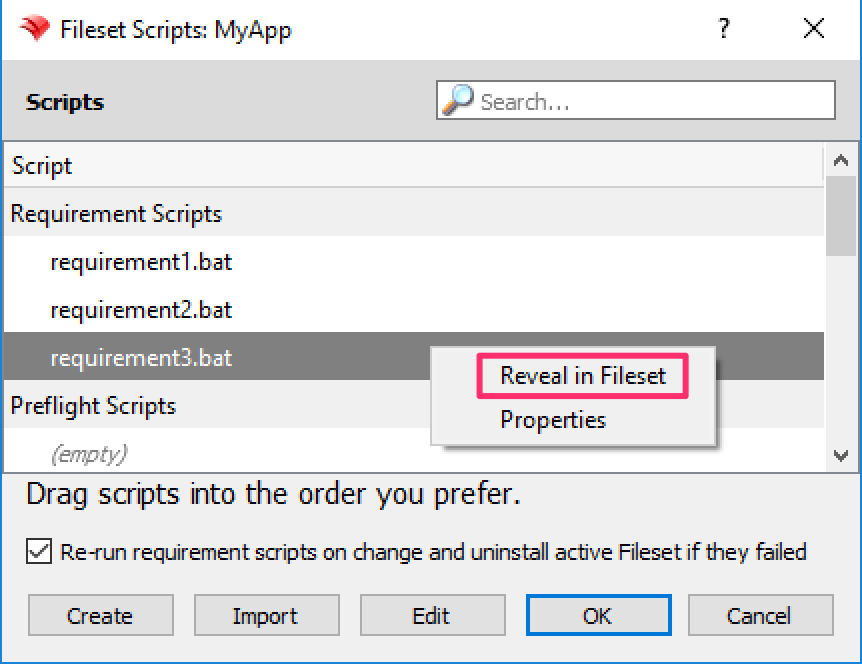
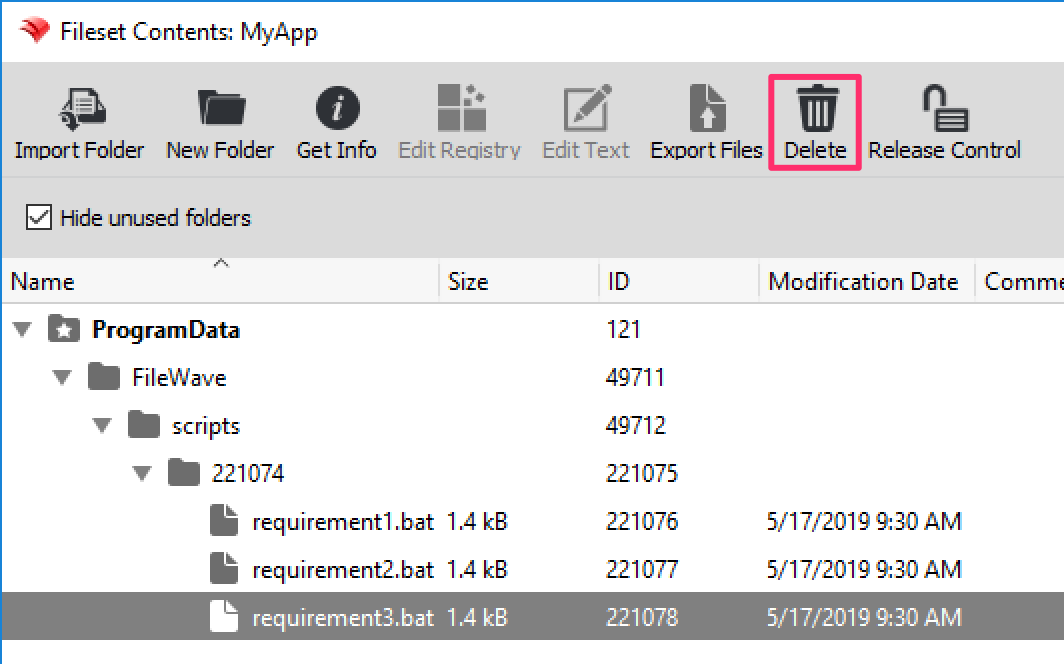
If you find that you need to delete a requirement script for any reason, right-click that script and choose Reveal in Fileset. That will open the Fileset Contents window with the script file highlighted. Click the Delete icon in the toolbar to delete your script.
Test requirement scripts locally before adding them to a Fileset. These examples provide building blocks for Windows Filesets that should install only when specific local conditions are true.
No comments to display
No comments to display